


From home Wi-Fi transformed into "perception butlers" to urban street lamp poles serving as environmental monitoring nodes, wireless sensing technology is permeating every corner of production and life as "invisible nerves". As a core sensing layer technology of the Internet of Things (IoT), China's wireless sensing field has achieved a leap from catching up to keeping pace under the triple drivers of policy support, technological innovation and scenario application. Despite facing some development bottlenecks, it is steadily moving towards high-quality development on the whole.

Policy dividends have laid a solid foundation for industrial development. Since the "National Informatization Plan during the 13th Five-Year Plan Period" clearly promoted the construction of IoT infrastructure, national-level policies have continuously released positive signals, from "Made in China 2025" to the "14th Five-Year Plan" Special Plan for Intelligent Manufacturing. Measures such as additional deduction of R&D expenses and special fund support have been adopted to encourage technological innovation and industrial upgrading. At the local level, industrial clusters in the Yangtze River Delta and Pearl River Delta have formed synergistic effects, with the Guangdong-Hong Kong-Macao Greater Bay Area accounting for 55% of the bidding share of smart city sensors, providing broad scenarios for technology landing. Guided by policies, China's wireless sensor market size is expected to reach 17.5 billion US dollars by 2025 and 26 billion US dollars by 2030, maintaining a double-digit compound annual growth rate.
Technological innovation has broken foreign monopolies, and application scenarios have continued to expand. The team from Tianjin University in China innovatively used sweeping robots to automatically construct home Wi-Fi signal maps, improving the sensing accuracy to 0.1 meters and solving the problem of signal obstruction in complex home environments; Suzhou Laitin achieved "one-network integration" of lighting, air conditioning and other equipment based on independently developed MESH wireless protocol, achieving an energy saving rate of over 85% in smart building scenarios. In the industrial field, wireless sensors have realized intelligent applications such as motor fault early warning and pipeline pressure monitoring. A car factory successfully warned of equipment shutdown risks 7 days in advance by deploying vibration sensors; in agricultural scenarios, the soil moisture sensor network in Shandong's wheat-growing areas has achieved the dual benefits of saving 40% water and increasing production by 15%. More notably, the layout of 6G "communication-sensing integration" technology has been launched. In the future, base stations will have both communication and sensing capabilities, providing new solutions for low-altitude safety, disaster early warning and other scenarios.
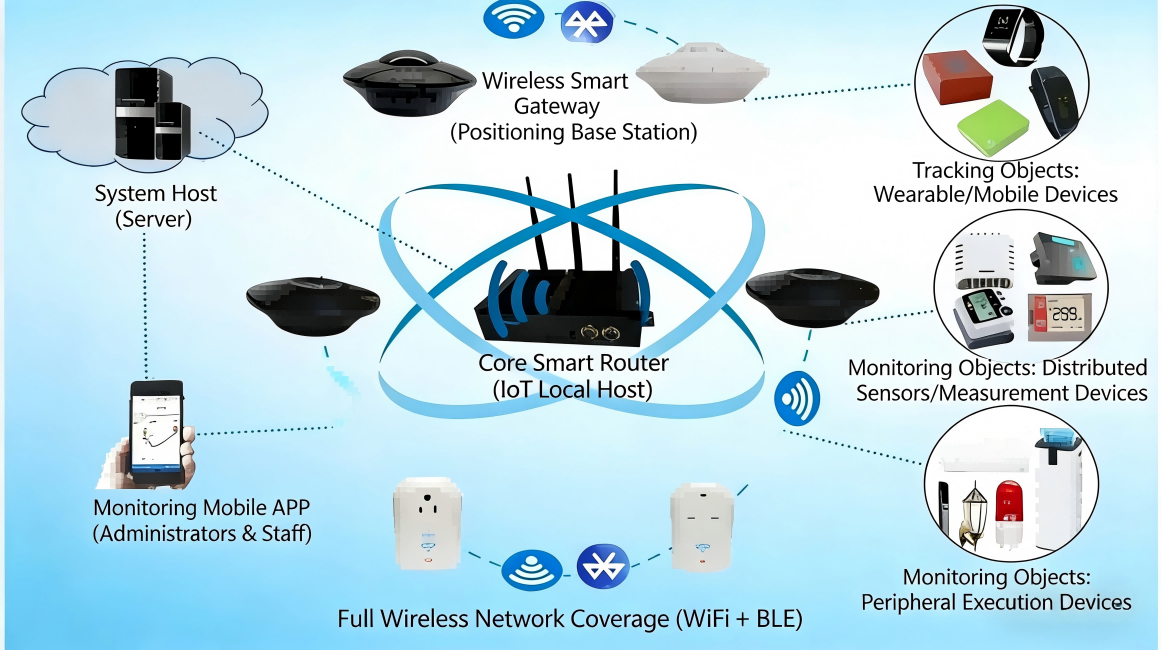
While developing rapidly, the industry still has shortcomings that need to be addressed urgently. At the core technology level, the high-end sensor chip market is still dominated by international enterprises such as TI and ST. Although the market share of domestic chips has increased to 7.8%, there is still a gap in key indicators such as accuracy and power consumption; in terms of the standard system, there are 17 communication protocols in the current market, leading to difficulties in interconnection and intercommunication of equipment from different brands and restricting large-scale applications; on the application side, issues such as sensing stability in complex environments, data security and privacy protection still require dual guarantees of technology and regulations. These challenges are not "roadblocks" to industrial development, but "catalysts" for technological iteration.
Looking to the future, China's wireless sensing field has broad development prospects. With the deep integration of edge computing and AI algorithms, the proportion of AI-enabled sensors is expected to exceed 75% by 2030; breakthroughs in energy harvesting technology will drive battery-free sensors to account for half of the market share. In tracks such as industrial predictive maintenance, medical wearable devices and smart city monitoring, domestic enterprises are achieving breakthroughs through vertical integration and differentiated innovation. The positive interaction between policy, technology and market will promote the extension of China's wireless sensing technology from consumer-level applications to industrial-level and high-end medical-level scenarios, injecting sustained momentum into the development of the digital economy.

From technological breakthroughs in laboratories to intelligent experiences in tens of millions of families, China's wireless sensing field has completed the development process that took developed countries decades in more than ten years. Facing up to shortcomings and continuing to innovate, this vibrant technology track is bound to become the core engine of global intelligent industry development.

