


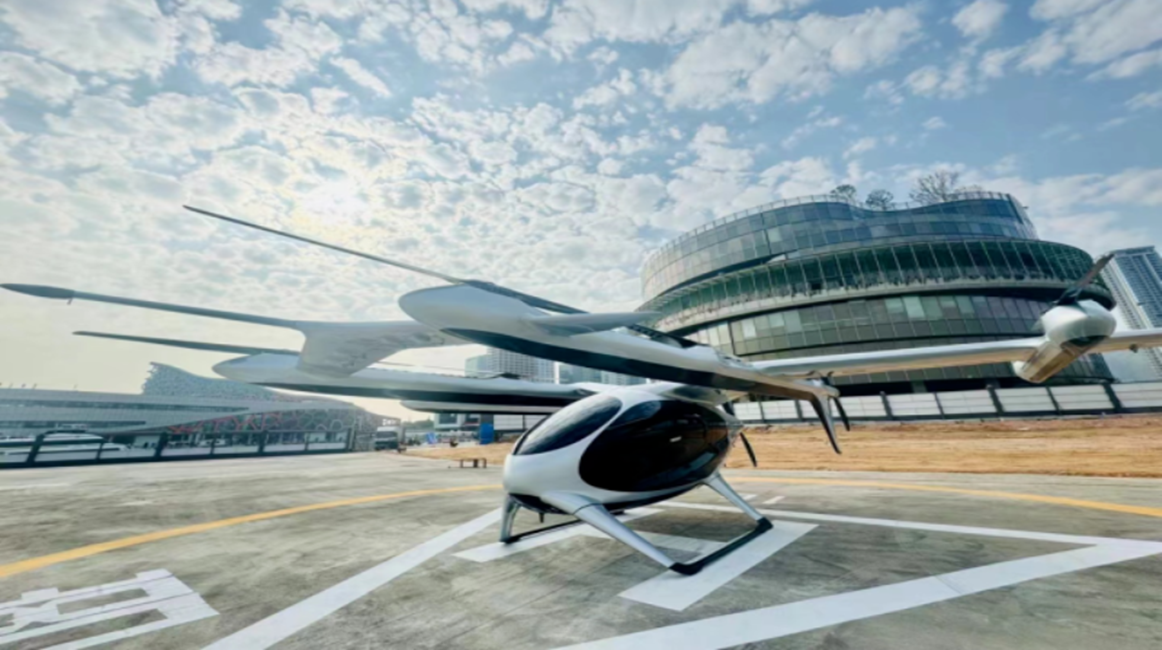
As a core component of low-altitude economy, electric vertical take-off and landing (eVTOL) aircraft, known as "flying taxis", have become a highlight of China's new-quality productivity. Featured in government work reports twice and included in the 14th Five-Year Plan, the industry is accelerating toward commercialization while facing doubts. A closer look at the facts, however, reveals its solid progress and bright prospects.

China's eVTOL development stands out globally with policy support and technological breakthroughs. The Civil Aviation Administration of China (CAAC) pioneered a "special conditions" certification model, significantly shortening the approval cycle—a practice praised internationally. EHang Intelligent made history by becoming the world's first enterprise to obtain four core certificates for its EH216-S model, completing the commercial closed loop from design to operation. This unmanned aircraft has achieved 76,000 safe flights globally and launched passenger services in Guangzhou and Hefei. Meanwhile, Xpeng Aeroht's smart manufacturing base, with an annual capacity of 10,000 units, is under construction, backed by over 5,000 pre-orders for its "Land Aircraft Carrier" model.
The first major controversy revolves around the validity of "intentional orders". Critics argue most orders lack legal binding and advance payments, dismissing them as ceremonial. In reality, these orders reflect genuine market demand: scenic spots and logistics companies sign them to seize opportunities, while for manufacturers, they boost financing capacity during the R&D phase. Importantly, definite progress exists beyond intentions—Yufeng Future is negotiating confirmed cargo eVTOL orders with delivery scheduled for 2026, proving the market's confidence in practical application.

Concerns about inadequate infrastructure are also being addressed proactively. While the "four networks" (facilities, communication, route, service) are still under development, China leverages existing resources wisely: traditional airports and helipads can be retrofitted for eVTOL use, and new buildings are required to reserve infrastructure space. With a construction cycle of only 3-5 months for take-off and landing points, infrastructure can keep pace with eVTOL commercialization. Enterprises like Time Tech are building integrated ecosystems in Wuhu, covering manufacturing, operation and financing to solve supporting issues systematically.
Safety worries, the most critical concern, are addressed through multi-layered guarantees. Distributed propulsion systems with multiple small thrusters enhance redundancy, while intelligent flight control with triple backup systems meets aviation-grade standards. The "cargo first, passenger later" principle adopted nationwide ensures risk control through gradual application. BCG predicts China's eVTOL market will reach $41 billion by 2040, opening a "third space" between ground transport and civil aviation.
Like the new energy vehicle industry that took a decade to mature, eVTOL development requires patience. China's unique advantages—complete industrial chain, innovative policies and huge market—have laid a solid foundation. As EHang's VT35 model expands inter-city application and cargo eVTOLs enter trial operations, the "flying taxi" is no longer a blueprint but a upcoming reality, ready to reshape China's urban mobility.

