


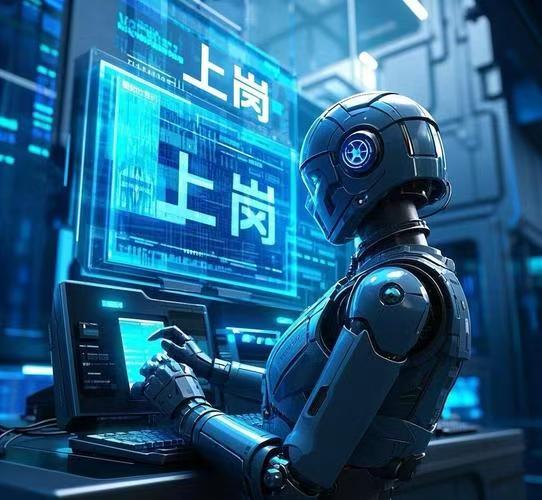
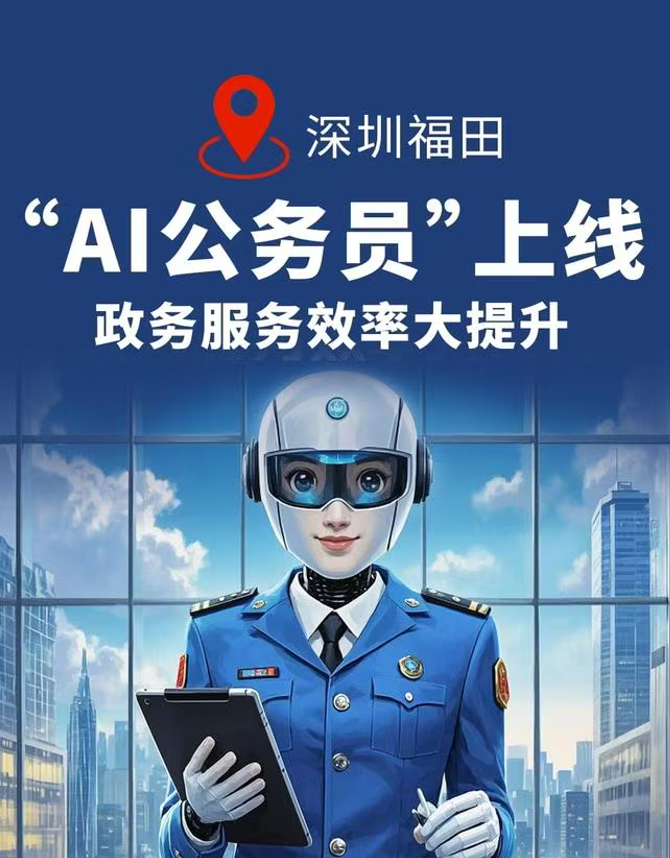
On February 16, 2026, a significant milestone in the integration of artificial intelligence and public administration was marked in China. Shenzhen, the country’s renowned tech hub, announced the official city-wide availability of the DeepSeek model for all its districts and departments, effectively weaving AI into the very fabric of its governance. The move captured global attention not merely for its technological ambition, but for its immediate, tangible outcome: in Futian District, the first 70 "AI digital employees" officially "clocked in". This development thrust a compelling question onto the world stage: What happens when AI enters the sacrosanct halls of government, a domain long symbolized by the stability of the "iron rice bowl"—a metaphor for the lifelong, secure employment traditionally offered by China"s public sector?
The deployment of these AI colleagues is not a futuristic experiment but a fully operational upgrade to Shenzhen"s digital governance infrastructure. The city has established a dedicated Huawei Ascend intelligent computing zone within its government cloud, creating a unified and efficient platform for AI capabilities. The DeepSeek-R1 model, a "full-parameter" version with 671 billion parameters, has been deployed in a secured environment, ensuring that sensitive government data remains within the system while being analyzed to boost efficiency. This move makes Shenzhen the first city in Guangdong province to implement such a comprehensive AI system within a government cloud based on indigenous technology. It represents a deliberate and strategic shift toward an "AI-first" approach to governance, aiming to create a city that operates on a foundation of pervasive, real-world AI applications.
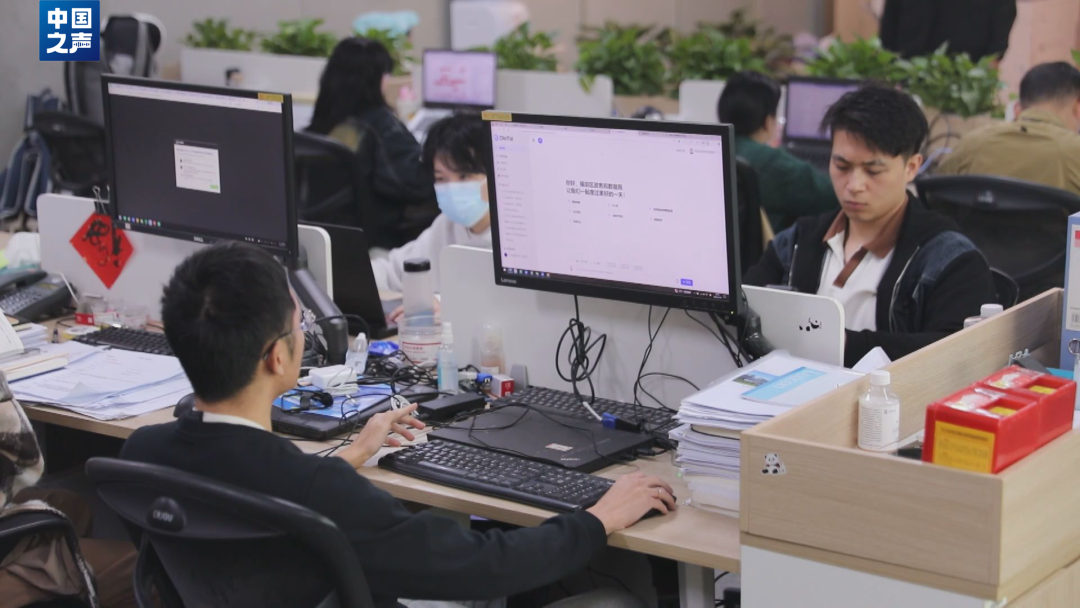
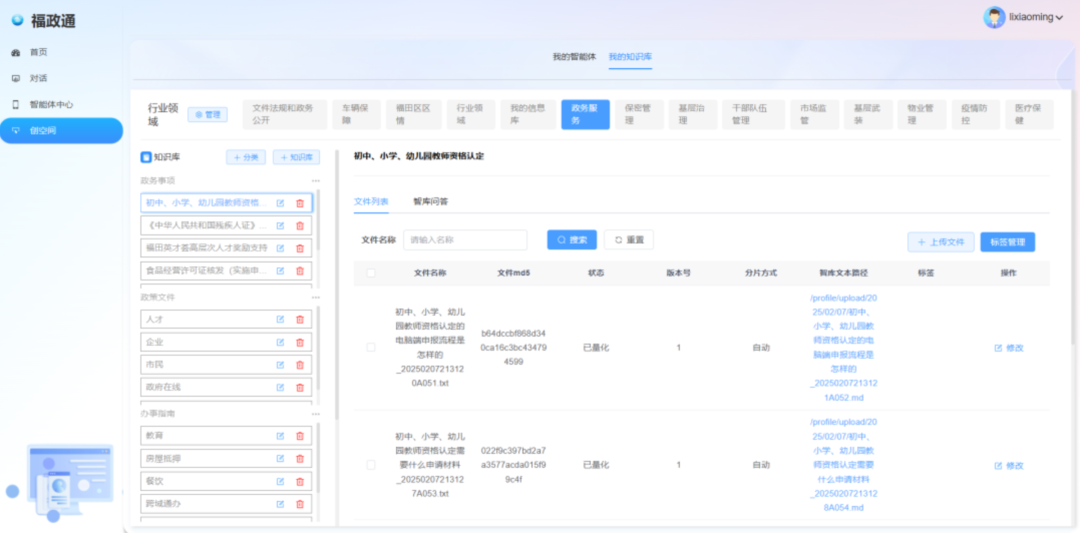
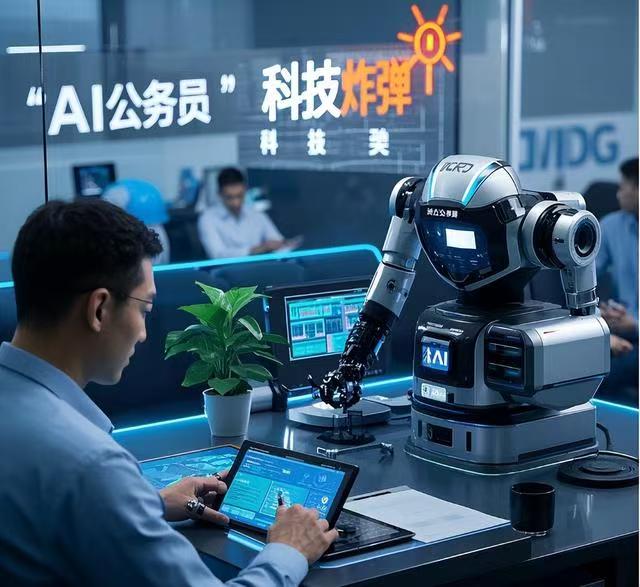
The impact is immediate and striking. In Futian District, the initial 70 AI agents are not humanoid robots walking the halls, but sophisticated software integrated into 240 core business scenarios, handling tasks with a speed and accuracy that no human can match. Their performance metrics read like a blueprint for administrative efficiency. For instance, the accuracy of document format correction has surpassed 95%, while the time required for document review has plummeted by 90%, from hours or even days to mere minutes. The process of assigning public complaints to the correct departments, a task that once took over three minutes on average and was prone to error, is now executed by AI in 0.9 seconds with an accuracy rate of 95%. A complex labor dispute ruling that might consume a human officer"s entire morning can now be drafted in 58 seconds, complete with proper legal citations. In the Longgang District of Shenzhen, an AI-powered video search function, using the city"s network of 230,000 cameras, has already helped locate over 300 missing persons, a testament to AI"s potential for profound social good.
However, the rise of these efficient, indefatigable digital employees has naturally stirred a complex mix of awe and anxiety. They require no salaries, no social insurance, no rest, and they never complain. Their capacity for processing initial applications is nearly eleven times that of a human worker. This inevitably raises the specter of job displacement. For generations, a position in China"s civil service has been seen as an unassailable "iron rice bowl," a career path offering unparalleled stability. The arrival of AI directly challenges this notion. Public discourse now buzzes with the question: Will AI completely shatter this bowl, leaving millions of civil servants obsolete?

The early evidence suggests a future that is more nuanced than a simple man-versus-machine showdown. While AI is indeed taking over a significant portion of work, it is primarily targeting the "repetitive" and "standardized" aspects of the job. These digital employees excel at tasks like data entry, initial document review, format checking, information retrieval, and the triage of public inquiries. This allows their human counterparts to be liberated from the drudgery of paperwork. As one district official noted, "In the past, we worked like information porters; now we have to transform into policy interpreters, emotional communicators, and innovation planners". The role of the human civil servant is evolving from a process executor into a complex problem-solver, a decision-maker who can apply nuance and empathy, and a manager of the very AI tools that now support them.
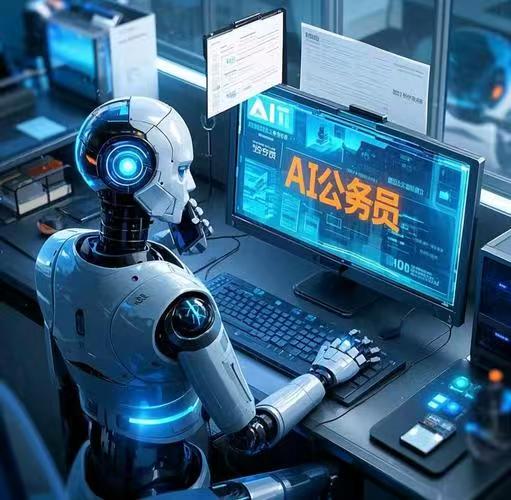
This fundamental shift in job roles is being described as the "catfish effect," a phenomenon where a dynamic force stirs up a stagnant environment, forcing everyone to adapt and improve. The AI is the "catfish," compelling the human workforce to swim faster and develop new skills. Every AI assistant in the government system is required to have a human "guardian" who supervises its output and takes ultimate responsibility for its work. This means that while an AI can draft a policy document, a human must ensure it aligns with community values and strategic goals. While an AI can allocate resources based on data, a human must make the final call in a crisis where human lives and emotions are at stake. The future of the civil service is not one of pure automation, but of "human-machine collaboration". The "iron rice bowl" is not being smashed, but reforged; it will require new skills and a new mindset to hold.
The implications of this pilot project extend far beyond the borders of Shenzhen. It serves as a real-world laboratory for the global challenge of AI integration into the workforce. The challenges faced in Shenzhen are the same ones that governments and corporations worldwide are beginning to grapple with. A report from the World Economic Forum predicts that by 2030, while technological change will create 170 million new jobs, it will also displace 92 million existing ones, resulting in a net shift of 78 million roles. The jobs most at risk are precisely the kind of mid-level, routine cognitive tasks that AI is now handling in Shenzhen. This has prompted serious discussions at the highest levels of China"s government, with the Ministry of Human Resources and Social Security announcing plans to introduce a policy document specifically to address AI"s impact on employment.
The emerging consensus among economists and labor experts is that the core issue is not simply the number of jobs, but their structure and quality. Without careful management, the widespread application of AI could lead to a "polarization" of the workforce. High-skilled, creative, and managerial roles may thrive, while many mid-level positions vanish, potentially pushing displaced workers into lower-paid, less secure service jobs, thereby widening the income gap. As one expert noted, "Restructuring does not mean disappearance, and evolution does not mean replacement". The goal, therefore, is to harness AI"s "job creation effect" as vigorously as its efficiency gains. This involves cultivating entirely new professions—AI trainers, data ethicists, prompt engineers, and algorithm auditors—roles that were barely imaginable just a few years ago but are now becoming essential.
For the civil servants of Shenzhen and beyond, this transformation necessitates a proactive approach to learning and adaptation. The new competitive advantage for a worker lies not in competing with a machine on its own terms, but in developing skills that machines cannot easily replicate. These include critical thinking, creativity, complex communication, emotional intelligence, and ethical judgment. The workforce of the future must become adept at acting as "AI commanders," learning to craft precise instructions and interpret AI-generated insights to enhance their own decision-making. This shift is already influencing recruitment, with a noticeable increase in demand for tech-savvy talent, including graduates in AI and related fields, within government agencies.
In conclusion, the arrival of 70 AI colleagues in a district of Shenzhen is far more than a local news story. It is a preview of a global, systemic shift in the nature of work. The experiment demonstrates that AI will not necessarily destroy the "iron rice bowl" overnight, but it will fundamentally redefine what it means to hold one. It is transforming a job once defined by stability and routine into a dynamic career requiring continuous learning, complex judgment, and a capacity for genuine human connection. The ultimate success of this transition will depend on a concerted effort from governments to establish forward-thinking policies and robust social safety nets, from educational institutions to reform curricula, and from individuals to embrace lifelong learning. Shenzhen has lit the fuse; the world is now watching to see how the landscape of work, and the role of humanity within it, will be reshaped in the brilliant, challenging light of the AI era.

