


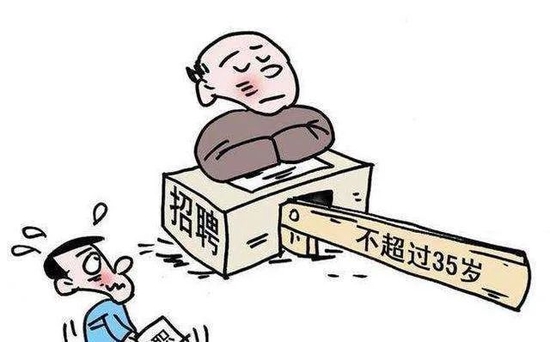
In recent years, the "35-year-old age threshold" has become a prevalent invisible barrier in the job market. Numerous middle-aged job seekers with solid experience and professional competence have encountered severe employment difficulties. Many enterprises impose explicit or implicit age restrictions to exclude middle-aged employees, triggering widespread social debates over employment equity, talent value and market rules. This practice of judging talents merely by age rather than competence has severely narrowed the employment space for middle-aged workers, resulted in the waste of high-quality labor resources, violated the legal principle of equal employment, and undermined the balance of the workplace ecosystem, making it an urgent livelihood and social issue to address.
Phenomenon Analysis: Normalized Age Discrimination and Imbalanced Employment Fairness
Workplace age discrimination falls into two categories: explicit restrictions and implicit exclusion. In industries such as internet, new media and service sectors, many recruitment notices explicitly prefer candidates under 35. General clerical and technical positions also adopt a one-size-fits-all age cap. Although public institutions have gradually relaxed age requirements for civil service and public institution recruitment, age barriers remain rigid in private enterprises. More covert than explicit rules, implicit discrimination is harder to identify. Enterprises filter out over-age resumes through recruitment algorithms and reject middle-aged candidates in interviews under excuses of “young team orientation” or “high-intensity work adaptability”, depriving middle-aged workers of their legitimate right to equal competition under the guise of compliance.
Such simplistic age screening disrupts the fairness of the job market fundamentally. Employment competition should be based on professional competence, personal quality and job adaptability rather than rigid age labels. Middle-aged workers boast solid professional skills, rich experience in risk management and stable work attitude, serving as vital pillars for corporate steady development. Nevertheless, they are unfairly judged and eliminated by biased age standards. Most middle-aged workers facing layoffs and re-employment suffer from repeated job-hunting failures and salary cuts. This not only hinders personal career development but also renders the legal principle of equal employment ineffective, further fueling disputes over workplace equity.

Root Causes and Social Impacts of Age Barriers
The formation of workplace age thresholds stems from the combined effects of market mentality, institutional deficiencies and social stereotypes. For enterprises, the short-sighted utilitarian mindset dominates recruitment decisions. Many employers believe that middle-aged employees bring higher labor costs and are less innovative and adaptable to emerging industries than young employees, thus taking age as a convenient and time-saving screening criterion. In addition, China’s workplace promotion system is relatively single. Most enterprises favor young management teams and lack long-term career paths for senior technical specialists and industry consultants. Middle-aged employees have limited promotion opportunities and are easily regarded as redundant manpower, which further solidifies the age-screening convention.
Institutional and social flaws also contribute prominently. Current employment laws fail to explicitly include age in the list of prohibited discrimination categories, relying merely on vague blanket clauses. This leads to difficulties in identification, evidence collection and law enforcement, resulting in insufficient regulatory deterrence. Supported by abundant young labor supply, enterprises have diverse recruitment options, making age discrimination low-cost and prevalent. Meanwhile, the deep-rooted social stereotype that “age equals capability” has normalized the “35-year-old career crisis” and aggravated age prejudice.
Age discrimination exerts far-reaching negative impacts on individuals and society. For middle-aged workers, frequent job rejections and salary downgrades, coupled with heavy elderly-supporting and childcare burdens, trigger widespread occupational and living anxiety. For society, the idleness of experienced labor causes severe talent waste, contradicts the national delayed retirement policy and creates an “employment vacuum” that reduces labor resource utilization. In the long run, rigid age prejudice intensifies workplace involution, discourages workers from long-term industry dedication and hinders the sound development of the job market.

Solutions and Positive Trends: Multi-stakeholder Efforts to Rebuild Fair Employment Ecology
Breaking workplace age barriers requires joint efforts from the government, enterprises and society to balance market efficiency and employment equity. Policy supervision serves as the core guarantee. Authorities should improve employment equity laws, explicitly incorporate age discrimination into regulatory rectification, refine identification standards and penalty mechanisms, and enforce corporate employment responsibilities. Human resources departments shall conduct regular big-data inspections on recruitment platforms, remove discriminatory recruitment information and rectify non-compliant enterprises to curb age discrimination at the source.
As major employers, enterprises must abandon short-sighted age prejudice and establish a competence and performance-oriented talent evaluation system. By building dual promotion channels for management and technical posts, enterprises can give full play to middle-aged workers’ strengths of rich experience and high stability. Many pioneering enterprises have relaxed age restrictions and prioritized job matching, setting industry benchmarks. Meanwhile, society should reshape traditional perceptions and eliminate age anxiety. Governments can provide targeted skill training for middle-aged workers to help them update professional knowledge, adapt to industrial upgrading and enhance core workplace competitiveness.
Employment equity underpins social fairness. With continuous policy implementation and the renewal of corporate employment concepts, workplace age barriers are gradually loosening. Abandoning biased age labels, respecting individual value and adhering to fair employment principles will activate labor vitality across all age groups, build an inclusive and equitable workplace ecosystem, and enable every worker to pursue career development through hard work and capability.

