


Nestled on the banks of the Yi River in Luoyang, a city that served as the capital for thirteen ancient Chinese dynasties, the Longmen Grottoes silently narrate a saga of faith, art, and imperial power that unfolded over centuries. To stand before these limestone cliffs is to witness a profound dialogue between humanity and divinity, carved directly into the face of the mountain. Stretching for approximately one kilometer, this open-air museum of stone hosts an awe-inspiring collection of more than 2,300 caves and niches, over 100,000 statues, and nearly 2,800 inscribed tablets. Recognized by UNESCO as the "apex of Chinese stone carving art," Longmen is far more than a static relic; it is a vibrant testament to the cultural sophistication, religious devotion, and artistic genius of ancient China, capturing a pivotal moment when a foreign faith, Buddhism, was seamlessly woven into the very fabric of Chinese civilization.
![XB5_O4R]K~PA_TPL]E1BRNB_tmb](/upload/images/2025/12/7d724d4a74bc9412.png)
The story of Longmen began not with a chisel, but with a strategic political decision. In the late 5th century, around the year 493 CE, Emperor Xiaowen of the Northern Wei Dynasty moved his capital from Datong to Luoyang. This northern nomadic tribe, having embraced Buddhism, had already initiated grand cave-temple projects at Yungang. The relocation southward marked a deliberate policy of adopting Han Chinese customs, and the artistic projects that followed, including the inauguration of the Longmen Grottoes, reflected this transformative agenda. The earliest caves at Longmen, therefore, were imperial endeavors, commissioned by the court to legitimize their rule and showcase their piety in their new heartland. This royal patronage set a precedent that would define Longmen for generations, distinguishing it as a site of national religious significance where the will of emperors and empresses was immortalized in stone. The carving activity continued intensively through successive dynasties—the Eastern Wei, Western Wei, Northern Qi, Sui, and most gloriously, the Tang—spanning over four hundred years of near-continuous artistic creation.
![V914V]Z9PJ8_NY`T[B0P`XQ_tmb](/upload/images/2025/12/2748b68cce7bae66.jpeg)
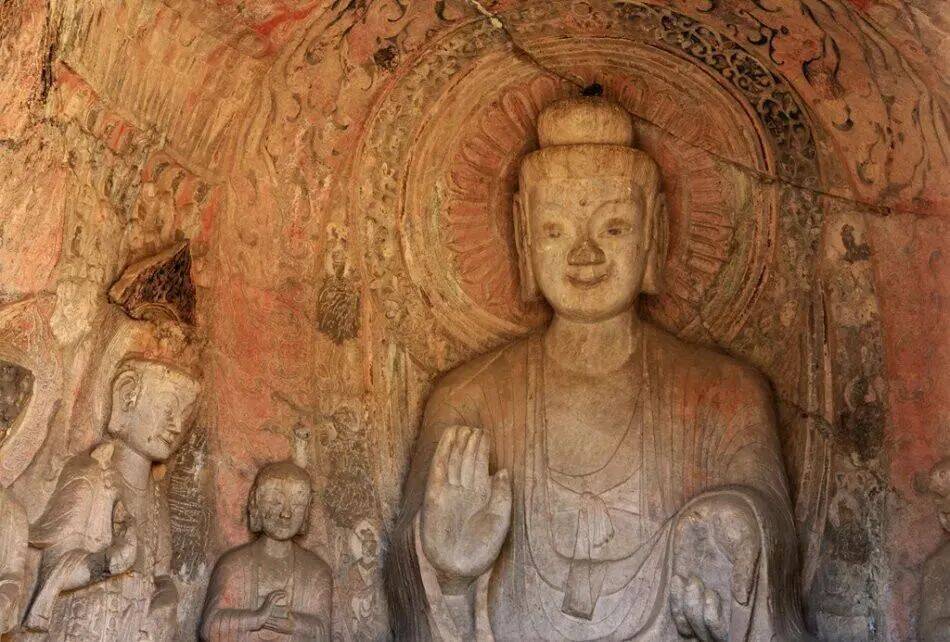
The artistic evolution visible across the cliffs mirrors the broader cultural shifts in medieval China. The early Northern Wei caves at Longmen initially showed the influence of the earlier, more robust and majestic Yungang style, which itself bore traces of Indian Gandharan influences. However, a distinct "Longmen style" soon emerged. Under the court's sinicization policies, the Buddhas and bodhisattvas shed their foreign demeanor. Their faces grew slender and elegant, their bodies leaner, and their expressions serene and introspective. Most strikingly, their heavy, draped monastic robes were replaced by the wide sleeves and flowing belts of Chinese scholar-officials, a style known as "broad robes with loose girdles" (bao yi bo dai). This was a conscious sinicization, adapting the Buddhist icon to align with the aesthetic ideals of the southern Chinese literati, creating what scholars call the "elegant and bony appearance" (xiu gu qing xiang). This transformation marked Buddhism's first major step in its visual journey toward becoming a Chinese religion.
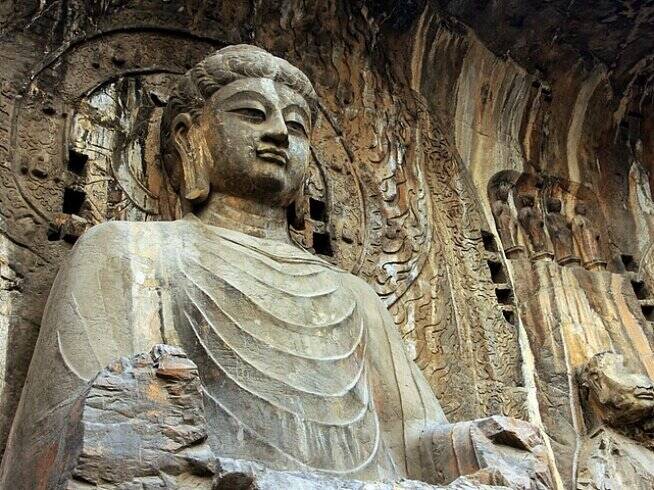
If the Northern Wei period established the sinicized form, the Tang Dynasty (618-907 CE) elevated it to a zenith of sublime expression and majestic scale. Buddhism reached a second peak under Tang patronage, and Longmen became the epicenter of this flourishing. The most intensive period of carving occurred during the reigns of Emperor Gaozong and the formidable Empress Wu Zetian. The culmination of this era, and indeed of the entire Longmen complex, is the Fengxian Temple, a colossal open-air alcove that is home to nine larger-than-life statues. Dominating the scene is the Vairocana Buddha, known as the Great Lushena, a figure soaring over 17 meters in height. With a face that is full and rounded, arched eyebrows over gently downcast eyes, and a subtle, enigmatic smile, the Buddha projects an aura of sublime compassion and lofty wisdom. The sheer grandeur of the figure is balanced by its palpable humanity, a blend of imposing majesty and gentle grace that embodies the confident, inclusive spirit of the High Tang. Legend, supported by historical records noting her significant financial contribution to the project, holds that the Buddha's face was modeled after Empress Wu Zetian herself, merging the divine with imperial authority in an unprecedented manner.
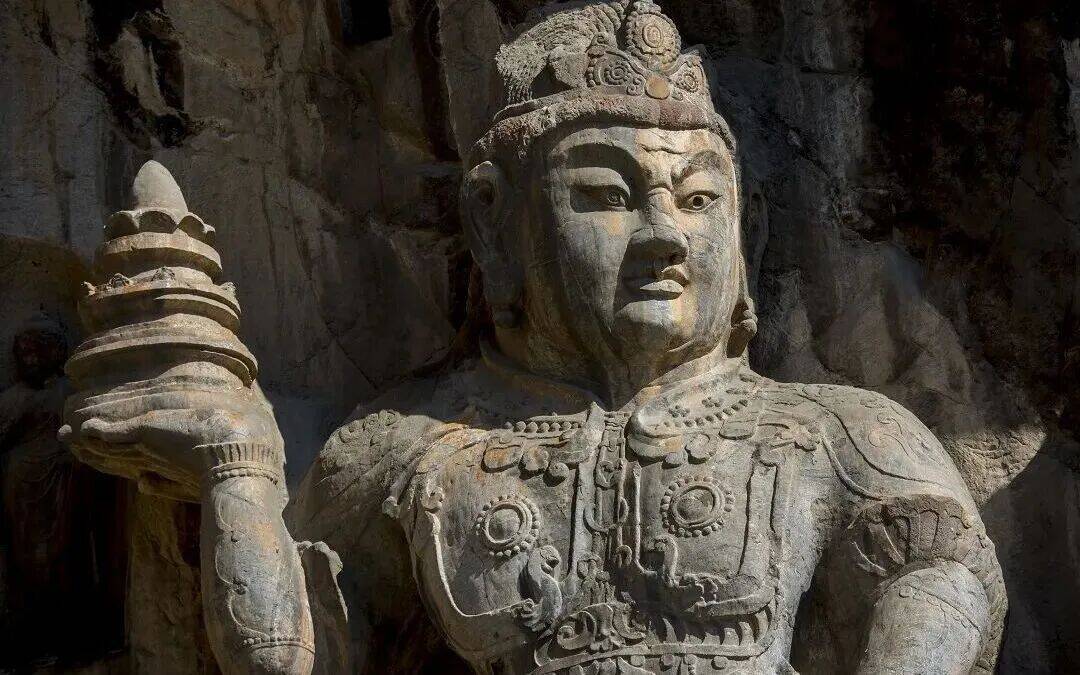
The Fengxian Temple ensemble is a masterclass in stone sculpture, each figure meticulously crafted to play a specific role within the cosmic hierarchy. Flanking the central Buddha are his earnest disciples, the serene and majestic bodhisattvas adorned with intricate jewelry, and fiercely guardian kings and muscular vajra protectors. This nine-figure grouping is not merely a display of artistic skill; it represents a mature, Chinese Buddhist theological vision and a scene of grand royal ritual frozen in time. The Tang style here is unmistakable: the figures are fuller, more lifelike, and exude a sense of earthy vigor and idealized beauty. The drapery falls with naturalistic weight, and the expressions range from divine compassion to ferocious protection, showcasing a dynamic realism that the earlier, more rigid Northern Wei figures did not possess. This mature Longmen-Tang style did not remain confined to Luoyang. It became a paradigm that had a profound influence on Buddhist art throughout East Asia, from the Dunhuang Grottoes to the bronze Buddha at Todai-ji Temple in Nara, Japan, and the stone carvings at Seokguram Grottoes in Korea.
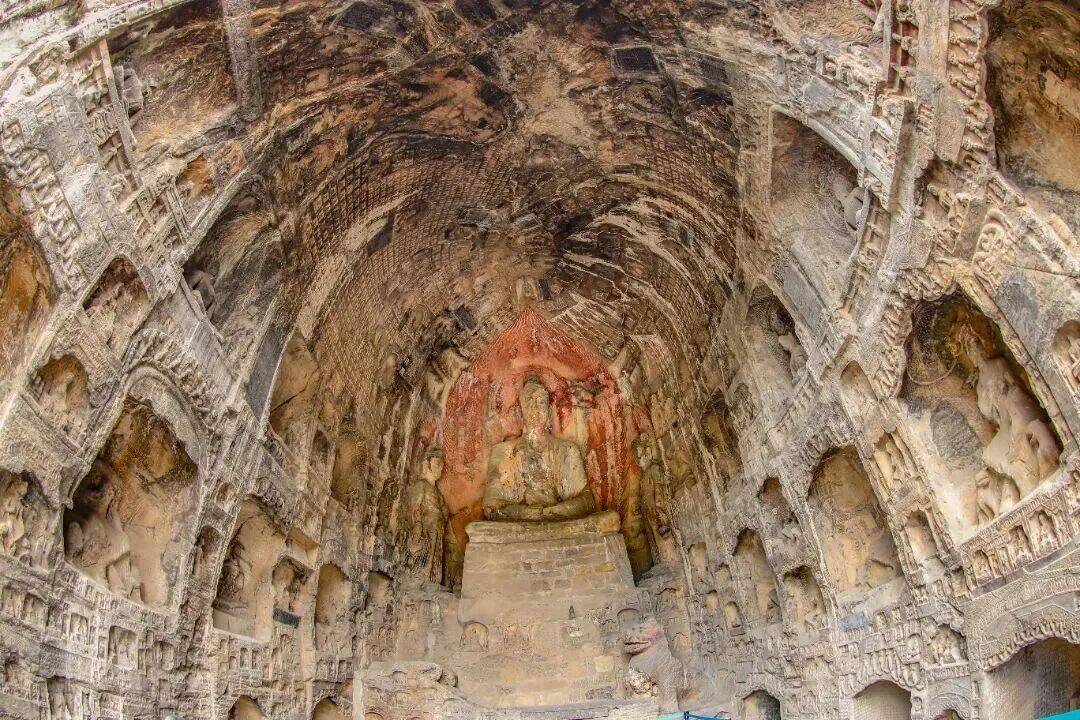
Beyond the iconic Buddhas, Longmen serves as an unparalleled encyclopedia of medieval Chinese life and cross-cultural exchange. The thousands of inscriptions, including the revered "Twenty Calligraphic Examples from Longmen," are treasures for historians and calligraphers, documenting the prayers, donors, and social events of the time. The caves are a repository of secular knowledge as well. For example, the "Prescription Cave" contains more than 150 prescriptions from the Tang Dynasty, making it one of the oldest and richest collections of stone-carved prescriptions in China.The international character of Tang-dynasty Luoyang, a terminus of the Silk Road, is etched into the stone. Sharp-eyed observers can find Central Asian musical instruments, patterns of European origin, and architectural motifs reminiscent of classical Greek columns, all absorbed into the decorative schemes of the caves. Some statues even depict figures seated in a Central Asian style, on chairs rather than the traditional Chinese floor mat, illustrating the vibrant flow of people and ideas into the cosmopolitan capital. This rich tapestry of carvings reflects, from myriad angles, the political, economic, and cultural developments of ancient China.
The journey of Longmen through the modern era has been fraught with both peril and promise. For centuries, the site suffered from neglect and even condemnation by some elites as a wasteful extravagance. The 20th century brought a more acute tragedy, as antique dealers and looters systematically vandalized the caves, severing countless heads and reliefs to feed the international art market. Over 700 spots bear the scars of this plunder. Masterpieces like the exquisite Northern Wei reliefs depicting the "Emperor and Empress Worshipping the Buddha" were cut apart and dispersed to museums overseas. Today, the guardians of Longmen face a relentless battle against time and the elements. Water seepage, air pollution, and natural weathering pose constant threats to the fragile limestone. In response, the Longmen Grottoes Research Academy has embarked on a sophisticated conservation mission. Utilizing ground-penetrating radar, 3D laser scanning, and infrared imaging, conservators conduct detailed "health checks" on the statues to diagnose internal cracks and moisture damage. The philosophy has shifted from simple repair to comprehensive, research-driven preservation that involves multidisciplinary collaboration.
Perhaps the most poignant and innovative aspect of modern stewardship is the digital resurrection of Longmen. By studying historical photographs taken by early 20th-century explorers and using advanced scanning technology, researchers are digitally reconstructing lost and damaged artifacts. Fragments scattered across the globe in institutions like New York's Metropolitan Museum of Art and the Nelson-Atkins Museum in Kansas City are being digitally reunited with their origins in Luoyang. Through 3D printing and virtual reality, the splendor of dismembered national treasures can be appreciated anew, offering a form of reconciliation for a painful history of loss. These digital archives also ensure that, even as the stone slowly yields to entropy, the form and spirit of these masterworks will endure for future generations. Public engagement has become central to this mission, with educational programs and even controlled public access to restoration sites fostering a shared sense of custodianship.
From its birth in an emperor's political vision to its status as a symbol of cultural confluence, the Longmen Grottoes stand as a monumental chapter in human artistic achievement. They chronicle the fascinating process of cultural adaptation, where a foreign religion was not just accepted but reinvented through a distinctly Chinese artistic lens, achieving what UNESCO describes as "the perfection of a long-established art form". The cliffs are a stone symphony, its movements composed across dynasties—from the solemn, elegant melody of the Northern Wei to the grand, harmonious crescendo of the Tang. More than a collection of ancient caves, Longmen is a bridge connecting the past to the present, China to the world, and earthly devotion to spiritual aspiration. It reminds every visitor that while empires rise and fall, the human impulse to seek meaning and create beauty, etched here with such perseverance and skill, can indeed aspire to eternity.

