


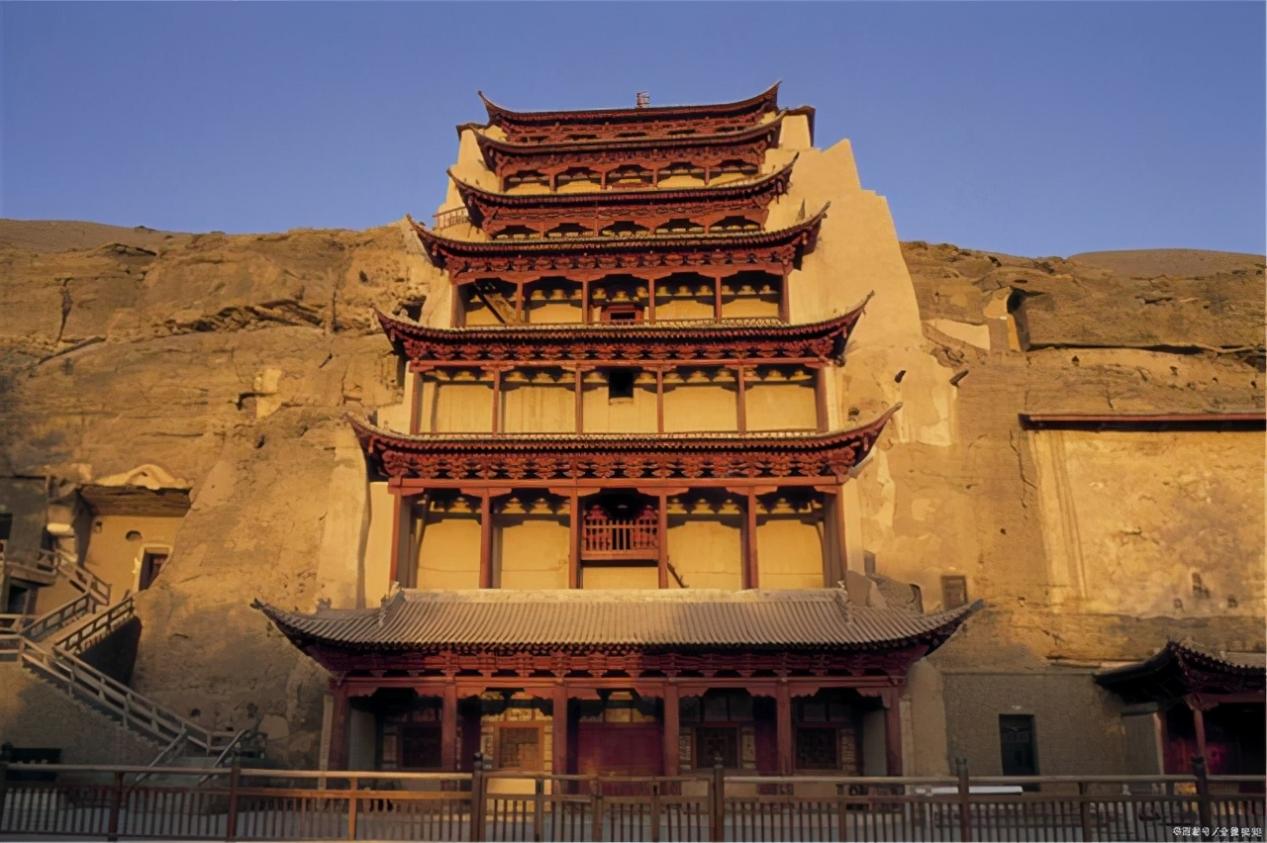
At the western end of the Hexi Corridor, on the cliff at the eastern foot of Mingsha Mountain, the Mogao Grottoes have stood quietly for more than 1,600 years. Commonly known as the Thousand-Buddha Caves, this complex of grottoes is a brilliant product of cultural integration along the ancient Silk Road. It integrates architectural, painted-sculpture and mural art, preserving cultural relics spanning more than ten dynasties. It is not only a precious artistic treasure of the Chinese nation but also a world cultural heritage shared by all humanity. Scattered along the over-one-kilometre-long cliff are more than 700 caves, housing over 40,000 square metres of murals and more than 2,000 painted sculptures. They tell stories of ancient religious beliefs, civilian life and exchanges between Chinese and foreign civilizations, unfolding a magnificent and splendid scroll of ancient art for later generations.
A Millennium of Construction: Birth of Grottoes at a Silk Road Hub
The history of the Mogao Grottoes began in 366 AD. According to legend, the monk Lezun passed by the spot and saw golden light shimmering over Sanwei Mountain, as if thousands of Buddhas had appeared. He carved out the first cave in the cliff face. Later, the monk Faliang continued the work, launching the long-term construction of the Mogao Grottoes. Located at the westernmost tip of the Hexi Corridor, Dunhuang served as a vital transport junction between central China and the Western Regions, with constant merchants and traders travelling through. Buddhism spread eastward along the Silk Road, laying fertile ground for the development of cave temples.
From the Sixteen Kingdoms period through the Northern Wei, Sui and Tang dynasties, to the Five Dynasties, Song, Western Xia and Yuan dynasties, craftsmen, nobles and ordinary people kept carving caves and making statues for over a thousand years. The Tang Dynasty, an era of national prosperity, marked the golden age of the Mogao Grottoes, when numerous large-scale caves were completed. After the Yuan Dynasty, as maritime trade routes rose to prominence, Dunhuang gradually faded from prominence and cave-digging came to an end. In 1900, the Library Cave was accidentally unearthed. Tens of thousands of scrolls, paintings and documents came to light, bringing the Mogao Grottoes back to global attention and giving rise to Dunhuang Studies. Regrettably, a great many precious artefacts were scattered overseas, leaving an irreparable historical loss. In 1987, the Mogao Grottoes were inscribed on the World Heritage List, winning worldwide recognition.
Brilliant Paintings: The Stunning Mural Art
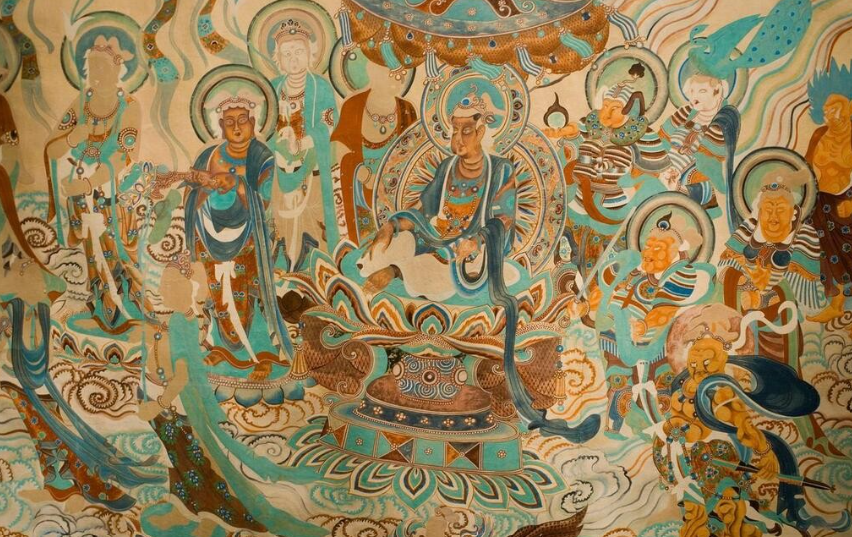
Murals represent the most dazzling highlight of the Mogao Grottoes. Covering cave walls and ceilings, the 45,000-square-metre murals cover an area equal to dozens of football pitches, with rich and diverse themes. There are solemn portraits of Buddhas and Bodhisattvas, jataka tales illustrating Buddhist reincarnation, and grand sutra paintings that visualize Buddhist scriptures in vivid scenes.
Flying Apsaras are the iconic symbol of Dunhuang murals. Instead of heavy wings, long flowing ribbons give them the illusion of soaring through the sky. Scattering flowers or playing musical instruments mid-air, they embody uniquely Chinese romantic aesthetics. Far more than mere Buddhist narratives, the murals form a visual record of ancient society. Scenes of farming, merchant camel caravans, feasts, dances and city architecture vividly recreate the daily lives of people from a thousand years ago. Ancient painters blended central-Chinese painting techniques with artistic styles from the Western Regions, producing magnificent colours and fluid lines that still impress viewers today. They provide irreplaceable visual resources for the study of ancient painting, costumes, architecture and folk customs.
Painted Sculptures: The Statue World inside the Grottoes
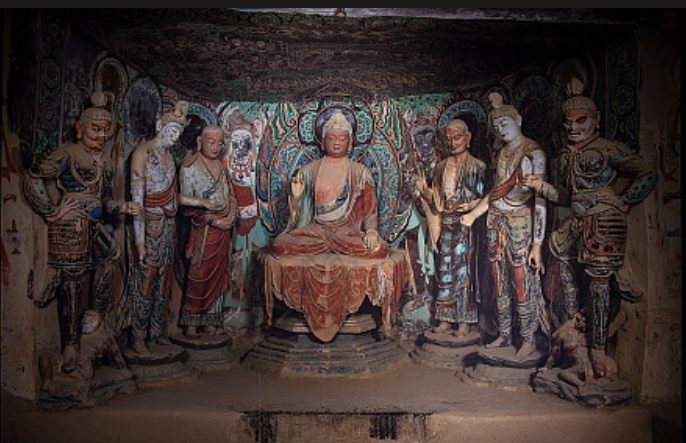
The loose sandstone of the Mogao cliff is unsuitable for stone carving, so painted clay sculptures became the main form of statuary. More than 2,000 painted sculptures survive, harmoniously complementing the murals to form complete artistic spaces inside each cave. The sculptures vary greatly in size, ranging from giant Buddha statues dozens of metres high to small Bodhisattvas, disciples and guardian warriors only tens of centimetres tall.
Tang-dynasty painted sculptures represent the peak of Mogao statuary art. Buddhas have full, gentle faces; Bodhisattvas look dignified and graceful; disciples show lifelike expressions; and guardian gods appear powerful and imposing, each with a distinct personality. Craftsmen modelled forms in clay before applying paint, gradually localizing imported Buddhist iconography with traditional Chinese aesthetic tastes. Within each cave, painted sculptures occupy the central position, surrounded by murals. Sculptures and paintings echo one another, creating a sacred atmosphere for Buddhist worship and demonstrating the superb modelling skills of ancient artisans.
Passing on the Legacy: Heritage Protection toward the Future
After centuries of wind and sand erosion, the Mogao Grottoes suffer from weathering, mural flaking and fading, and rock-wall cracking. Generations of conservators have devoted themselves to cultural-relic protection in the desert. Early work included cliff-face reinforcement and mural restoration. Today, sensors monitor temperature and humidity inside caves, advancing scientific preventive conservation.
The Digital Dunhuang project has opened new paths for inheritance. Researchers carry out high-precision scanning of caves and murals to convert precious relics into digital resources. Even visitors unable to travel to the Gobi can explore the caves online, allowing millennium-old art to transcend geographical boundaries and reach the world. Protecting the Mogao Grottoes means safeguarding not only caves and paintings on cliffs, but also the historical memory of ancient civilizational exchanges.
Wind drifts over Mingsha Mountain as time goes by, yet the Mogao Grottoes still stand. They embody the ingenuity of ancient craftsmen and bear witness to cultural encounters along the Silk Road. As a window for understanding history, they remind modern people to cherish cultural heritage, so that this millennia-old oriental artistic treasure may keep radiating new vitality in contemporary times.

