


A Time-honored Invention Rooted in Chinese Civilization
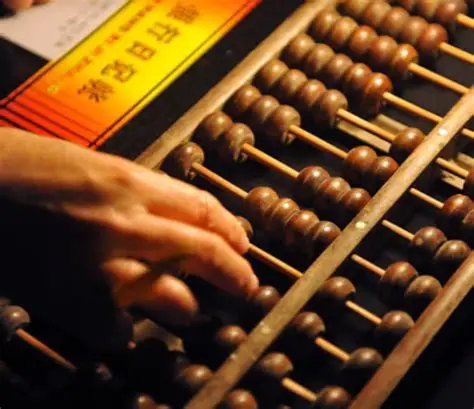
As a representative mathematical invention of ancient China, the Chinese abacus embodies the computational wisdom of the Chinese nation spanning thousands of years, and is hailed as "the world’s oldest computer". It boasts a long-standing and well-documented developmental history. As early as the Shang and Zhou dynasties, ancient Chinese people developed rudimentary counting and calculating methods, laying the foundation for the birth of the abacus. In the Eastern Han Dynasty, Notes on Ancient Mathematical Arts written by Xu Yue formally recorded the term "abacus" for the first time. The phrase "governing the four seasons, coordinating the three fundamental powers" summarized its core operational principles, marking the initial formation of abacus theory.
After embryonic development in the Qin and Han dynasties and iterative improvement in the Tang and Song dynasties, abacus techniques gradually matured. The structure of the abacus was finalized, and a systematic set of calculating formulas was established. The Yuan and Ming dynasties witnessed its golden age. Widely applied in commercial transactions, tax accounting and land measurement, the abacus became the universal calculating tool across the country. In the Ming and Qing dynasties, abacus skills gained further popularity. As an essential skill for people’s livelihoods, it evolved into a complete knowledge system, deeply integrated into ancient people’s production and life, and witnessed the prosperity of ancient Chinese economy and mathematics.
Exquisite Design: Unique and Ingenious Computational Wisdom
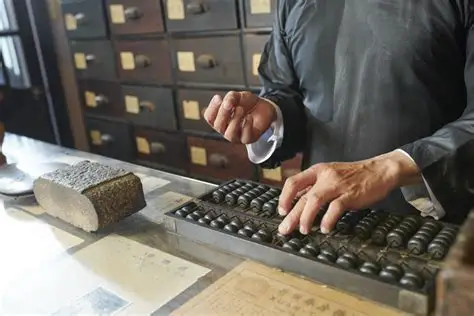
The charm of the abacus lies in the perfect combination of its simple structure and sophisticated algorithms. Featuring a neat frame and orderly beads, it follows the core rule of "one upper bead representing five and one lower bead representing one", forming an efficient counting system. This seemingly simple tool incorporates profound mathematical logic of decimal system and positional notation, reflecting the ancient Chinese people’s wisdom of simplifying complex mathematical problems.
Different from mechanical calculation, the abacus operates based on a complete set of easy-to-learn and catchy formulas for addition, subtraction, multiplication and division. During calculation, fingers move nimbly on the beads, enabling the coordination of eyes, hands and brain and transforming abstract numerical operations into tangible fingertip movements. As a vivid practice of ancient Chinese mechanized mathematical thinking, this unique calculating method assisted the human brain in completing complex operations. In ancient times without advanced technology, it greatly improved calculation efficiency and accuracy, meeting the needs of various daily and professional computational scenarios.
An Enduring Cultural Treasure Renowned Worldwide
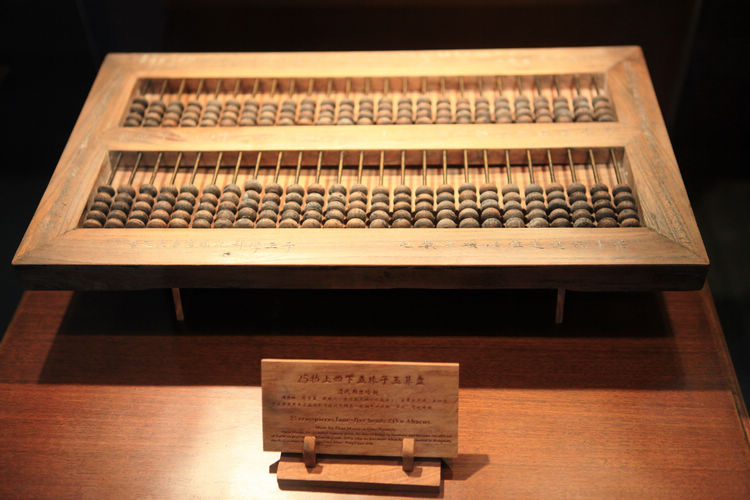
Far more than a mere calculating technique, the abacus serves as a cultural symbol of Chinese civilization, embodying the rigorous, pragmatic and meticulous spirit of the Chinese nation. In traditional culture, the abacus carries rich symbolic meanings. A "golden abacus" symbolizes diligence and prosperity, while an "iron abacus" represents impartiality and preciseness. The ancient abacus enshrined in the Dongyue Temple, inscribed with the motto "accurate in every calculation, fair in every judgment", expresses the ancient people’s pursuit of fairness, justice and self-discipline, making it an indispensable part of Chinese folk culture.
As a precious carrier of traditional Chinese culture, the abacus has won worldwide recognition for its cultural value. It was included in China’s National Intangible Cultural Heritage List in 2008. In 2013, UNESCO inscribed the Chinese abacus on the Representative List of the Intangible Cultural Heritage of Humanity, praising it as "an alternative knowledge system for the world" and a precious crystallization of ancient human wisdom. Originating in China, abacus culture has spread to East Asia, Southeast Asia and over a hundred regions worldwide, acting as a vital bridge for international cultural exchanges.
Ancient Charm with a New Vitality: Contemporary Inheritance and Innovation
In the digital era, with the widespread popularity of computers and electronic calculators, digital computing has become mainstream, and the practical computational function of the abacus has gradually faded. Nevertheless, this millennia-old craft has never faded from the modern world. Shedding its practical tool attribute, it has gained new vitality as a cultural and educational treasure. Derived from traditional abacus techniques, mental abacus calculation inherits its operational logic perfectly. Through long-term training, learners internalize the image and rules of the abacus in their minds, enabling rapid mental calculation without physical tools. This training method coordinates eye, hand and brain movements, effectively improving concentration, memory, responsiveness and logical thinking ability. As an excellent early childhood intelligence development approach, it is widely recognized by the public.
Today, abacus culture has entered primary and secondary school courses, intangible cultural heritage exhibition halls and cultural research and study activities. Professional teaching materials and inheritance courses have been continuously optimized, and various popular science activities, skill competitions and cultural exchange events are thriving. Modern inheritance of the abacus focuses not only on mastering calculating skills, but also on carrying forward traditional mathematical culture and craftsman spirit. Transcending its identity as a calculating tool, it has become an important carrier for inheriting Chinese mathematical culture, cultivating scientific thinking and fostering rigorous personal qualities. Every bead and every gear of the abacus bears the accumulation of thousands of years of civilization and embodies the innovative wisdom and pragmatic original aspiration of the Chinese nation. Crossing thousands of years of history and breaking through the limitations of technological iteration, the ancient abacus thrives in the new era, allowing the timeless wisdom of Chinese civilization to shine endlessly.

