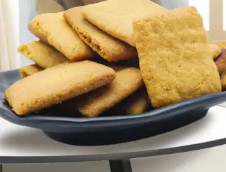


Wandering through the mountains of Shizhu in southeastern Chongqing, one encounters the layered stone slabs of the "Salt-Tea Ancient Trail"—a historic route that once linked Sichuan and Hubei. Tucked away along this path is a traditional staple of the Tujia people: *Linxi* handmade biscuits. Originating during the Republic of China era, these biscuits served as essential provisions for salt porters and merchants traveling the rugged terrain. Durable and portable, they have endured for a century, evolving into a local "Intangible Cultural Heritage" delicacy. Each thin, crisp biscuit carries the echoes of the ancient trail and the authentic, hearth-warmed spirit of Tujia life.
Unlike the elaborate, mass-produced snacks found in today’s markets, *Linxi* handmade biscuits are crafted from simple, honest ingredients: locally milled wheat flour, farm-fresh eggs, cold-pressed rapeseed oil, and sugar. Free from artificial flavorings or preservatives, their rich aroma emerges solely from the natural interplay of these ingredients—a testament to the enduring charm of traditional methods. The entire process relies entirely on the artisan’s intuition, with no precision instruments to dictate the parameters. Sugar, eggs, and rapeseed oil are thoroughly blended before being mixed with flour to form a dough. The most critical stage is natural fermentation; the dough is left to rest patiently, allowing the essence of the wheat to deepen and mature. Once properly fermented, the dough is kneaded repeatedly by hand to remove air bubbles, then rolled into a sheet of uniform thickness. It is trimmed and cut into neat, square pieces, which are then carefully arranged on baking trays. The baking process depends entirely on the seasoned master’s experience—judging the temperature and timing by the color of the biscuits. As they bake slowly over a gentle heat, they gradually expand and take on a warm, golden hue. Even the slightest deviation in heat can drastically alter the texture. While machines can achieve rapid mass production, they cannot replicate the delicate, airy crispness that comes from hand-rolling and natural fermentation. Freshly baked Linxi biscuits are incredibly fragrant, boasting a uniform, pale-yellow hue. Light and crisp to the touch, they crumble instantly upon the first bite. Their sweetness is gentle—never cloying—while a rich, wheaty aroma, accented by a subtle hint of rapeseed oil, unfolds in the mouth, growing more fragrant with every chew. They remain crunchy even after cooling, and when stored in an airtight container, they resist softening for a long time—a quality that once made them the preferred provision for travelers, who would tuck a pack into their bags to sustain themselves while trekking across mountains and valleys. Beyond the traditional original flavor, artisans are now introducing new varieties—such as buckwheat and red bean—to suit modern tastes, giving this classic treat a fresh, contemporary appeal.
In the old workshops of Linxi Town, the sounds of kneading, cutting, and baking have echoed through generations. Once a vital source of sustenance for porters traversing the ancient "Salt Road" (Ba-Yan Ancient Trail), these biscuits accompanied them across countless peaks. Today, they serve as a culinary emblem of Shizhu’s cultural tourism—a taste of nostalgia for locals who grew up eating them, and a small, tangible token for visitors venturing deep into the mountains of southeastern Chongqing to discover the ancient heritage of the Tujia people. Devoid of any flashy packaging, a single, crispy, fragrant bite offers a true taste of the century-old history of the Salt Road.