


Wudang Mountain: A spiritual sanctuary perched on cliffs—a celestial city that has been a place of spiritual practice for thousands of years.
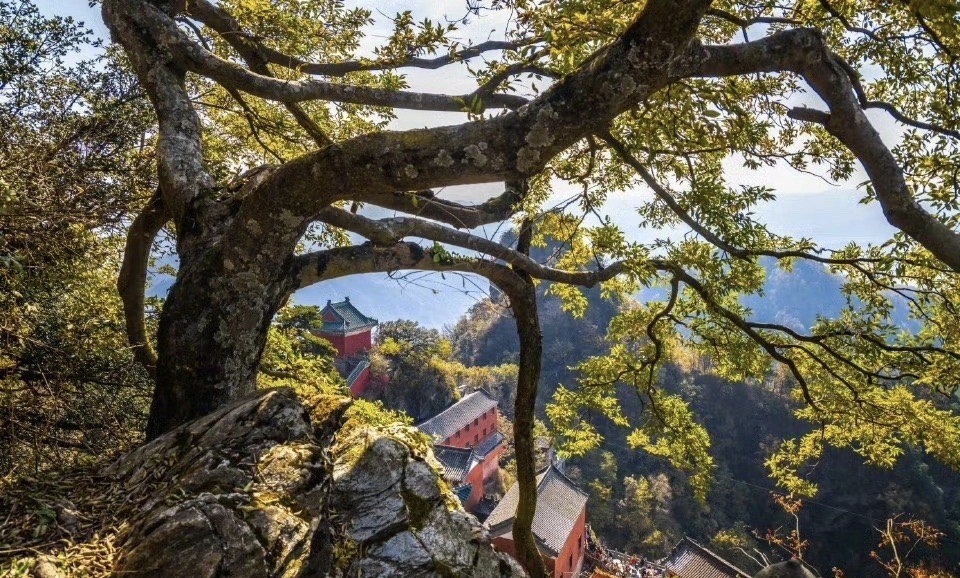
In 1994, when UNESCO experts first stepped into the Wudang Mountain Gorge, they thought they were reading a martial arts novel—on the edges of steep cliffs, vermilion palaces seemed to grow out of the rock, their upturned eaves piercing through the sea of clouds. This ancient architectural complex, known as the "Land of Immortals in the Clouds," was not a myth or legend but a declaration of faith carved by Chinese Taoists over nearly a millennium on the cliff faces. In 1994, the Wudang Mountain Ancient Architectural Complex was inscribed on the World Heritage List, with UN experts praising it as representing "the highest achievement in the integration of Chinese religious architecture with the natural environment." Since then, this sacred Taoist mountain suspended above the sky has begun telling the world an Eastern dream of harmony between heaven and humanity.
I. From Imperial Dreams to a Sacred Mountain: The Millennium-long Development History of Wudang
The story of Wudang Mountain is an epic that integrates imperial authority and Taoist cultivation into its very fabric. As early as the Han Dynasty, Taoist priests had lived in seclusion here practicing alchemy. However, it was Emperor Yongle of the Ming Dynasty, Zhu Di—who ascended the throne through a coup—whose actions truly transformed Wudang Mountain. To demonstrate the divine right of kings, he ordered thirty thousand craftsmen to launch an unprecedented "divinity creation campaign" on the mountain in 1412. He claimed that the Taoist deity Zhenwu Dadi attained enlightenment here, and that he himself was the incarnation of Zhenwu.
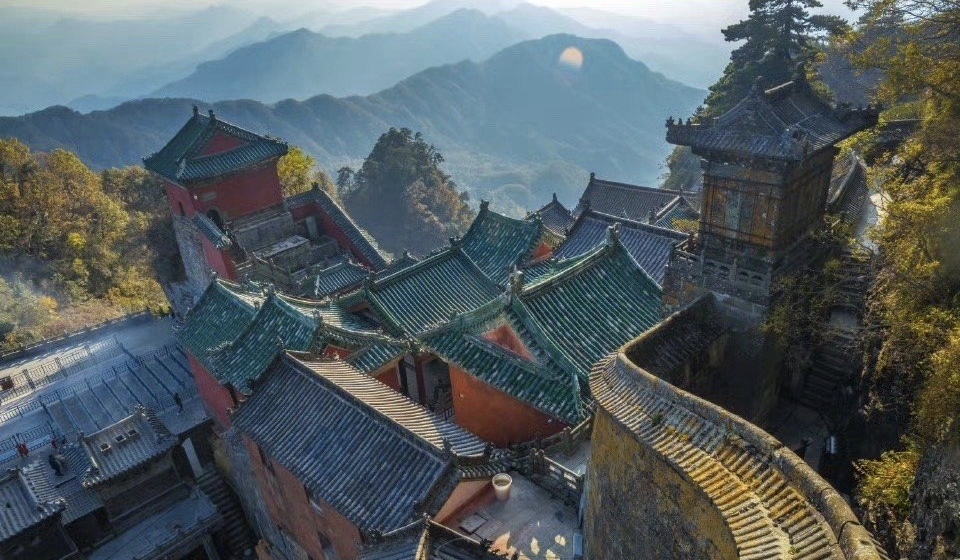
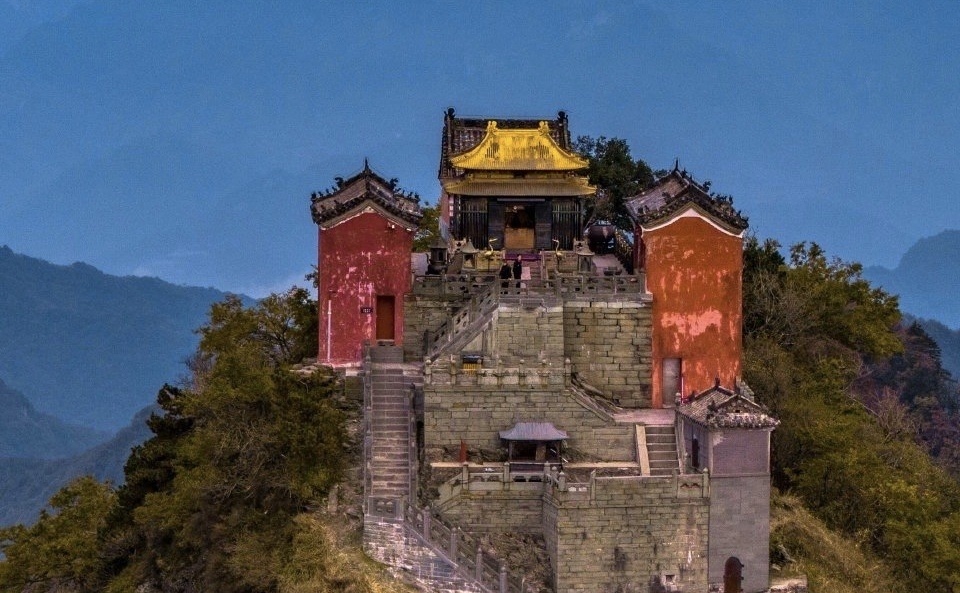
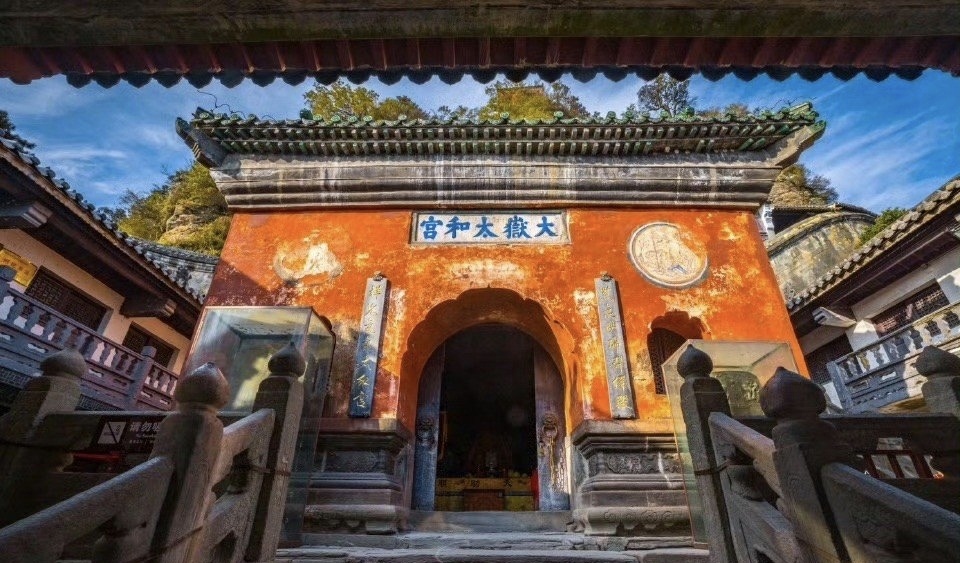
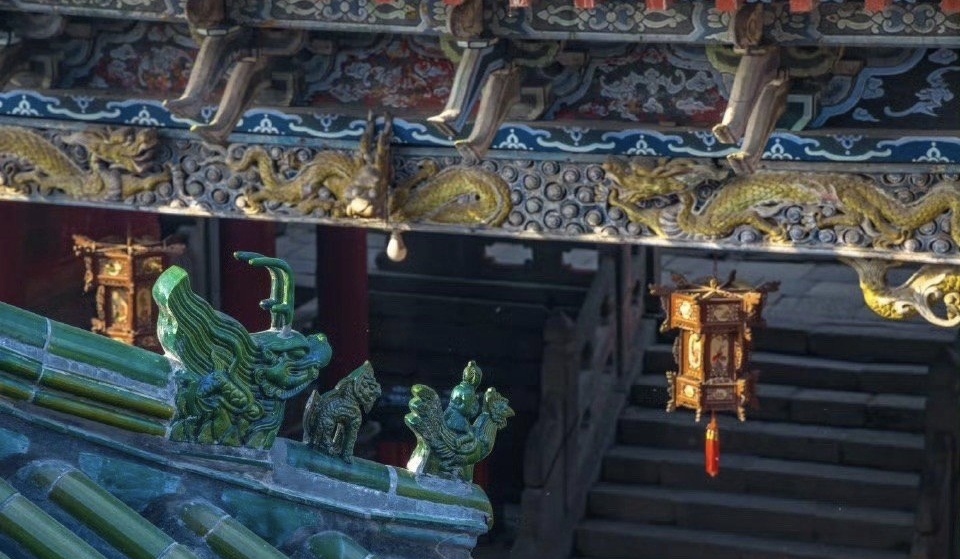
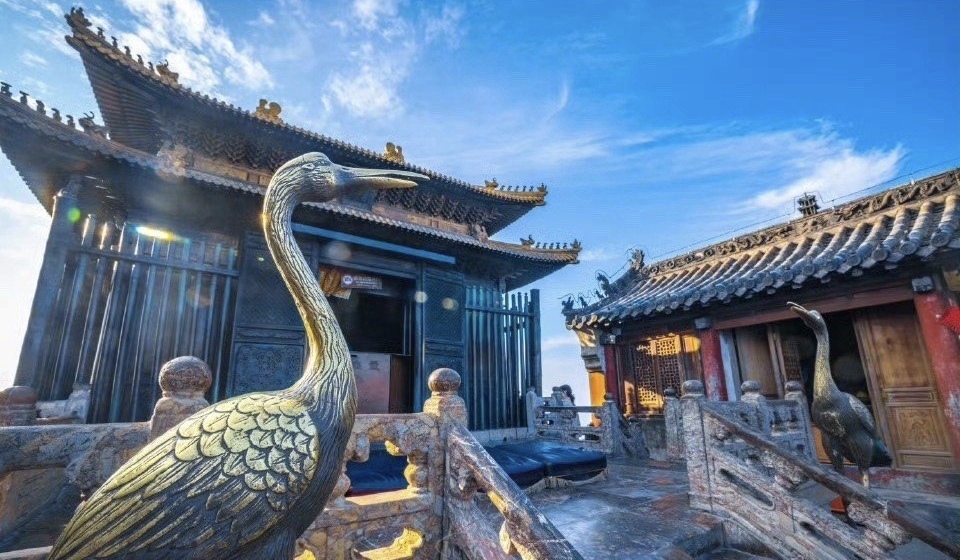
Over the next twelve years, the Nine Palaces, Eight Observatories, Thirty-Six Nunnery Halls, and Seventy-Two Rock Temples were constructed sequentially along a 70-kilometer mountain trail, extending from Xuan Yue Gate at the foot of the mountains to the summit of Tianzhu Peak at an altitude of 1,612 meters. All building materials—including copper-cast hall components weighing several tons, fully carved bluestone railings, and tens of thousands of glazed tiles—were transported entirely by human labor and pack animals along the steep path. Most remarkable is the Golden Hall, a bronze structure modeled after wooden architecture atop the peak, entirely gilded and having withstood six centuries of storms and weathering without any deformation. It represents not only the pinnacle of imperial casting craftsmanship during the Ming Dynasty but also a political declaration left by Zhu Di for posterity: "The decree of the Son of Heaven reaches directly the ears of Heaven."
II. The Philosophy of Building Along the Cliff: A Tangible Expression of Taoism's Concept of "Non-action"
Upon entering any temple on Wudang Mountain, one is struck by a unique tension: the architecture does not conquer the mountain terrain but rather engages in a dialogue with the cliffs. The "Dragon Head Incense Burner" at Nanyan Palace is particularly breathtaking—a stone-carved dragon head extends from the sheer cliff face; at the end of the stone beam, barely wide enough for a person to pass, this was once the perilous spot where Taoist priests burned incense and worshipped heaven. Zixiao Palace exemplifies another aspect of wisdom: situated in a basin embraced by mountains, it is backed by Zhanqi Peak and faces Yujichi Pond, perfectly embodying the Taoist principle of "concealing wind and gathering qi."
This layout is by no means accidental but a three-dimensional manifestation of the Taoist cosmology. The temples at the foot of the mountain symbolize human spiritual practice, the hermitages on the hillside represent progressive enlightenment, while the golden hall atop the summit represents the celestial realm beyond mortal reach. Every architectural element—including orientation, room dimensions, and number of columns—adheres to the principles of Yin-Yang and the Five Elements; even the sound of water dripping from eaves is designed as part of the spiritual practice. The most ingenious feature is the "one pillar with twelve beams" system: twelve horizontal beams extend from a single main column to support the entire structure, conserving materials while embodying the Taoist wisdom of "using minimal resources to achieve maximum effect." The craftsmen of Wudang Mountain used wood and stone to address a fundamental question: How can humans engage in dialogue with heaven and earth without damaging nature? The answer lies in constructing their dwellings as integral parts of the mountain itself.
III. From a Sacred Site of Martial Arts to a Global Symbol: The Cultural Journey of Wudang Mountain
The Western world first truly "got to know" Wudang Mountain, perhaps through Li Mubai's graceful light-kung skills in the film *Crouching Tiger, Hidden Dragon*, or the Tai Chi wisdom of Master Turtle in *Kung Fu Panda*. Yet Wudang Mountain's international journey began long before that. As the birthplace of Tai Chi and internal martial arts, Wudang martial arts have been introduced worldwide since the 1970s via Hong Kong martial arts films. Today, over 300 million people globally practice Tai Chi, with its presence ubiquitous from New York's Central Park to Paris' Luxembourg Gardens, where it is commonly seen among morning exercisers.
In 2003, Taoist priests from Wudang Mountain traveled to Frankfurt, Germany, to attend the World Congress of Religions. Their live demonstration of Wudang martial arts made European audiences realize for the first time that martial arts is not merely combat techniques but also a form of mobile meditation. Since then, Wudang Mountain has established Tai Chi exchange centers with countries including Italy, France, and Brazil, attracting tens of thousands of international practitioners annually. In architecture, its "cliffside architecture" inspired Swiss architect Peter Zümtöer's Valais thermal baths, which similarly pursue a natural aesthetic where buildings appear "cut by water like stone." UNESCO has designated Wudang Mountain as a "model of mountain religious architecture in East Asia," influencing the design of mountain temples in Japan and South Korea. What Wudang Mountain offers is not just an architectural style but a way of thinking: true greatness lies in learning to humbly integrate into the earth.
IV. Incense Burning and Tourists: The Dual Challenges of a Sacred Mountain
However, beneath its allure, Wudang Mountain is grappling with profound challenges. The greatest challenge stems from the influx of tourists—before the pandemic, it welcomed over 9 million visitors annually. At Zixiao Palace in the early morning, drones and selfie sticks have replaced the morning bells once sounded by Taoist priests; on the cliffside walkway at Nanyan Palace, the constant stream of tourists makes it impossible to hear the chanting carried by the wind. Over-commercialization has raised concerns among some devout Taoists: their originally sacred alchemy rooms have been converted into souvenir shops, forcing priests to relocate to more remote caves. Meanwhile, the six-century-old wooden halls are deteriorating rapidly due to damp mountain winds, leaving restoration efforts faced with a dilemma between preserving historical authenticity and meeting modern safety standards.
There have also been encouraging initiatives. Since 2015, the Wudang Mountain Special Zone has implemented a "tourist quota reservation system" and revived the Taoist spiritual practice tradition that had been interrupted for six decades—now over 300 Quanzhen Sect Taoists reside within the temple complex, observing strict morning and evening rituals without performing ceremonies or selling talismans. Several abandoned rock temples have been transformed into "meditative workshops," where international visitors can experience three-day retreats involving silence meditation, scripture copying, and herbal collection, rather than merely visiting superficially. The digitalization team is using laser scanning to document every beam and pillar, creating a three-dimensional archive. These efforts all address the same fundamental question: How can this millennia-old sacred mountain continue to serve as a center of faith without becoming a theme park?
For travelers from afar, Wudang Mountain offers an opportunity to reconsider the very meaning of travel. You can climb to the Golden Summit at 4 a.m. to witness the sunrise painting the sea of clouds in golden hues, imagining how artisans six centuries ago offered prayers with clasped hands under identical lighting; visit the Taoist clinic at Zixiao Palace where an elderly Taoist priest performs pulse diagnosis and explains the wisdom of the *Huangdi Neijing* through herbal remedies; or walk around the Nine-Bend Yellow River Wall at Taizi Slope with your eyes closed—it is said that completing the entire route without touching the wall brings inner tranquility. At that moment, you will realize that Wudang Mountain's "Tao" is not some esoteric concept, but rather the sound of mountain breezes passing through eave bells, the grooves etched on bluestone steps by countless pairs of straw sandals, and the Taiji patterns revealed when Taoist priests sweep away fallen leaves.
It whispers to every climber: The sacred is not in the clouds, but within your slowed breath as you ascend step by step.

