


The Eternal Guardians of the Underworld Empire: The Millennium-Old Secrets of Emperor Qin Shi Huang's Mausoleum and the Terracotta Army
More than thirty kilometers east of Xi 'an City in Shaanxi Province, China, at the northern foot of Lishan Mountain, beneath a lush grove of persimmon trees, lies the resting place of an emperor from over 2,200 years ago. His mausoleum is one of the largest, most uniquely structured, and richest in content among imperial tombs worldwide, as well as one of the most astonishing archaeological discoveries on Earth—the Mausoleum of the First Qin Emperor. One kilometer east of his tomb, a vast underground army composed of more than 8,000 life-sized terracotta figures has silently guarded their emperor for over two centuries. This silent army is known as the Terracotta Army, hailed as the "Eighth Wonder of the World." Since its accidental discovery by a group of farmers digging wells in 1974, the Mausoleum of the First Qin Emperor and the Terracotta Army pits have become a cultural landmark that every traveler must visit. For any international visitor seeking to understand the pinnacle of ancient Chinese ambition, power, and artistry, standing before these vividly detailed terracotta figures with distinct faces is like opening a time portal to China's first unified empire. In 1987, UNESCO inscribed the Mausoleum of the First Qin Emperor (including the Terracotta Army pits) on the World Heritage List, describing it as "a miracle of ancient human civilization, embodying the military organization, artistic achievements, and philosophical concepts of early China's empire." This imperial dream, dormant for twenty-two centuries, continues to tell a story of conquest, immortality, and eternity to the world in its silent yet majestic manner.
Origin and Development: An Emperor's Eternal Obsession and the Blood and Sweat of 700,000 People
The construction of the Mausoleum of the First Qin Emperor began at a groundbreaking moment in Chinese history. In 247 BCE, Ying Zheng, then only thirteen years old, ascended the throne of Qin. Shortly after his accession, he commenced the construction of his mausoleum on Lishan Mountain—a practice that was not uncommon at the time, as successive Chinese emperors had consistently upheld the principle of "treating the dead as if they were alive." However, the subsequent achievements of this young ruler led to the mausoleum's scale far surpassing that of any previous era. In 221 BCE, Ying Zheng unified the six states, proclaimed himself the "First Emperor," and became the first emperor in Chinese history. After unification, he became even more obsessed with achieving immortality: on one hand, he dispatched alchemists to sea to seek elixirs of life; on the other, he accelerated the construction of the mausoleum on an unprecedented scale.
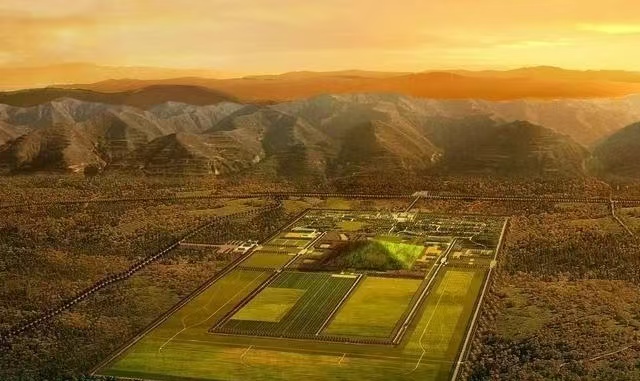
According to the Records of the Grand Historian: The Basic Annals of Qin Shi Huang, during the peak phase of the mausoleum construction, over 700,000 convicts and craftsmen were conscripted—a figure nearly equivalent to one percent of the nation's total population at the time. The entire complex spans 56 square kilometers, equivalent to 78 times the size of Beijing's Forbidden City. At its core stands a pyramid-shaped burial mound originally 115 meters high (now approximately 76 meters after more than two millennia of weathering), with a base circumference of about 2 kilometers. The underground palace is unfathomably deep; legend recounts that it "traverses three springs, descends through bronze channels to reach the coffin," uses mercury to simulate rivers and seas, adorns celestial bodies with night pearls, and employs mermaid fat as eternal lamps—precisely the eternal realm crafted by the emperor who aspired to rule the empire even after death.
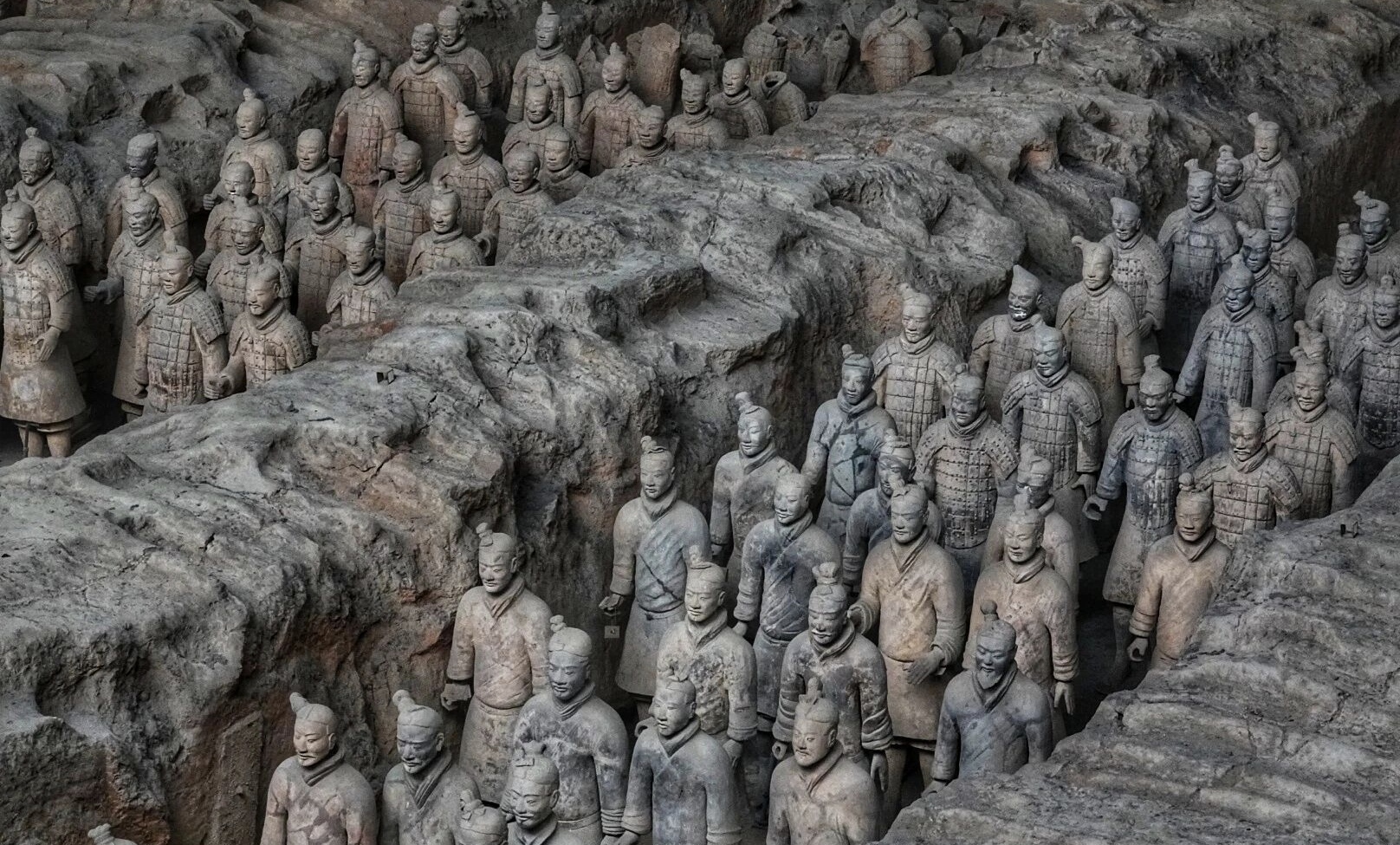
The world-renowned Terracotta Army serves as the guardian of the emperor's underground kingdom. Archaeological excavations reveal that these pits are located on the eastern side of the mausoleum complex, with four identified pits in total: Pit No.3 functioning as the command center, Pit No.2 housing a mixed military formation, and the largest Pit No.1 primarily comprising infantry and chariots featuring over 6,000 terracotta figures arranged in a complete rectangular formation. Each soldier figure stands approximately 1.8 meters tall—equivalent to or even taller than real humans—with distinct facial features, hairstyles, and expressions, all clad in armor and wielding authentic bronze weapons. The entire army faces eastward, toward the direction where Qin Shi Huang unified the six former states, symbolizing his perpetual surveillance of his once-subjugated territories. Notably, these terracotta figures represent only the outer burial pits on the eastern side of the complex. Remote sensing surveys have identified hundreds of additional burial pits throughout the site, including those containing stone-armored figures, bronze chariots and horses, acrobatic performers, and civil officials, collectively forming a comprehensive microcosm of the imperial empire.
Construction of the Mausoleum of the First Qin Emperor began when he ascended the throne at age thirteen and continued for thirty-eight years until it was forced to halt in the second year of Emperor Qin Er Shi's reign (208 BCE) due to warfare. However, merely four years after its completion, the Qin Empire collapsed. When Xiang Yu invaded Guanzhong, he set fire to all above-ground structures; the Terracotta Army pits suffered severe damage—tunnels collapsed and the figurines were shattered. From then on, both the mausoleum and its underground army vanished entirely from human memory, buried beneath the loess for twenty-two centuries until they were rediscovered in the early 20th century.
A Chance Miracle: A Corner of History Uncovered by a Group of Well-Digging Farmers
The discovery of the Mausoleum of the First Qin Emperor and its Terracotta Army stands as one of the most dramatic archaeological events of the 20th century. In March 1974, a group of farmers in Xiyang Village, Lintong County, Shaanxi Province were digging a well on a barren plot of land south of the village to combat drought. When they reached a depth of about four meters, they suddenly unearthed red-fired soil and charcoal ashes, followed by pottery human heads, severed limbs, and bronze arrowheads. The news was promptly reported higher up the chain of command, and the ruins once again astonished the world. Wang Yeqiu, then Director of the National Cultural Heritage Administration, immediately dispatched experts to the site. Zhao Kangmin, then a cultural heritage specialist at the Lintong County Cultural Center, was the first to recognize the significance of these pottery fragments. Through his preliminary excavations, the outline of Pit No.1 of the Terracotta Army began to emerge. In August 1975, the State Council decided to establish the Museum of the Terracotta Army of the First Qin Emperor on-site. The museum officially opened to the public on October 1, 1979, coinciding with the 30th anniversary of the founding of the People's Republic of China.
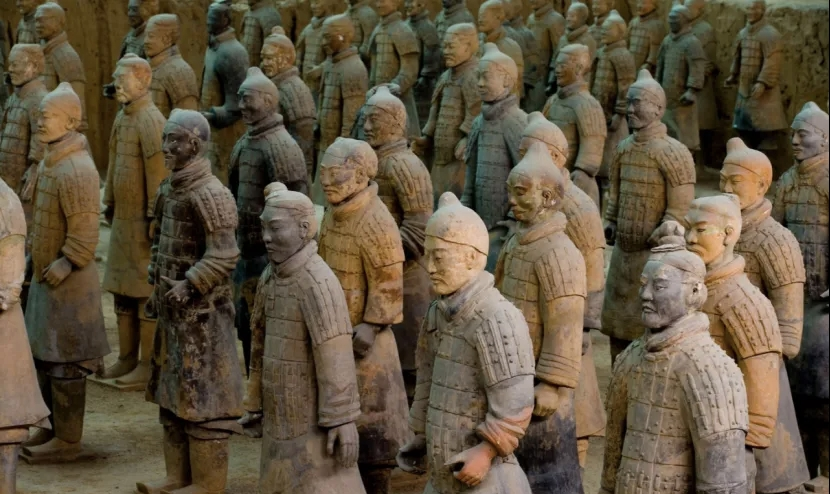
The excavation work was then fully launched. Pit No.1 measured 230 meters in length and 62 meters in width, covering a total area of approximately 14,260 square meters. Over several years of cleaning, fragments of more than 6,000 terracotta figures, over 50 war chariots, and hundreds of terracotta horses were numbered, restored, and repositioned. Subsequently, Pits No.2 and No.3 were also identified and excavated. Pit No.2 was particularly impressive, comprising four formations: war chariots, cavalry, crossbowmen, and others; it yielded over 1,300 terracotta figures, 89 war chariots, and 356 terracotta horses. Pit No.3 was the smallest, measuring only 520 square meters, but the remains of wooden war chariots and figurines of high-ranking military officials indicate that it served as a command post. Together, these four pits form a complete military deployment system, demonstrating the rigor and efficiency of Qin Dynasty military organization.
The unearthed weapons are equally breathtaking. Among the tens of thousands of bronze artifacts are gongs, spears, halberds, pikes, swords, crossbow mechanisms, arrowheads, and more. Some bronze swords feature a protective layer of chromium oxide approximately ten micrometers thick that effectively prevents corrosion—a technique known as "chromium salt oxidation" which was not reinvented until the 20th century in Germany and the United States. Even more remarkable is the phenomenon of "memory metal" observed on one bronze sword: when pressed by a pottery figurine for over two millennia, the blade instantly straightened upon removal. These groundbreaking technologies continue to inspire research among materials scientists and archaeologists worldwide.
International Dissemination: A World Tour of an Army of Terracotta Warriors
The discovery of the Terracotta Army of Emperor Qin Shi Huang quickly sparked a global "Qin Army craze." This silent military force soon transcended national borders, becoming the most impactful ambassador in China's cultural diplomacy.
The first large-scale overseas exhibition of the Terracotta Army took place in the early 1980s. From 1983 to 1985, the "China: The Terracotta Army Exhibition" toured cities including Osaka, Tokyo, and Nagoya in Japan, attracting over three million visitors and setting a historical record for foreign cultural exhibitions in Japan at that time. Subsequently, the exhibition began to reach Europe and America. In 1985, the Terracotta Army arrived in Berlin, Germany, and was displayed in a temporary pavilion near the West Berlin Zoo railway station. During the Cold War period, citizens of East Germany even risked crossing the Berlin Wall to visit the exhibition. After the exhibition concluded, the mayor of West Berlin remarked sincerely: "The Berlin Wall could prevent people from entering, but it could not stop the awe-inspiring impact of the China army from two thousand years ago on the residents of Berlin."
Over the following decades, the global tour of the Terracotta Army has never ceased. World-renowned art institutions such as the British Museum in London, the Metropolitan Museum of Art in New York, the Louvre in Paris, and the National Archaeological Museum in Madrid have all hosted brief exhibitions featuring this terracotta army. When it was exhibited at the British Museum in 2007, tickets were sold out two months in advance, with daily queues extending around the entire museum district. British media commented: "The appeal of this underground army far surpasses that of any state visit by a living prominent figure." According to incomplete statistics, by the end of 2025, the Terracotta Army had been featured in nearly 100 thematic exhibitions across more than 40 countries and regions worldwide, attracting over 50 million overseas visitors.
In recent years, the global promotion of Terracotta Army culture has entered a new digital phase. In 2025, the Emperor Qin Shi Huang's Mausoleum Site Museum signed a memorandum of cooperation with the Louvre Museum in France on the "Digital Terracotta Army" initiative, jointly developing an immersive VR experience titled *The Qin Army and Napoleon: A Military Dialogue Across Two Millennia*. Drawing inspiration from both nations' iconic military heritage sites, the project creates a virtual cross-temporal dialogue space accessible to global audiences via online platforms or physical exhibition halls. That same year, the "Terracotta Army VR Cinema" debuted at the Mobile World Congress in Barcelona, Spain; visitors wearing head-mounted displays could virtually enter the excavation site of Pit No.1 or even fly above the entire Lishan Mausoleum complex, experiencing a sensation akin to real-world travel. This project was awarded the "Best Cultural-Technological Integration Innovation Award" at the event.
International Impact: The Miracle of the Qin Empire in a Global Context
The discovery of the Mausoleum of the First Qin Emperor and the Terracotta Army pits has completely transformed the international academic community's understanding of ancient Chinese civilization. Before the 1970s, many Western historians remained skeptical of the accounts of the Qin mausoleum in the Records of the Grand Historian, considering them merely literary exaggerations by later generations to glorify Emperor Qin Shi Huang. However, the emergence of the Terracotta Army pits provided irrefutable physical evidence that confirmed the authenticity of Sima Qian's descriptions: "passing through three springs, descending bronze vessels to reach the coffin chamber," and "palaces, official residences, rare artifacts, and treasures filling them to capacity." UNESCO's inscription on the site as a World Heritage Site explicitly states: "This is a masterpiece of human creativity, technical prowess, and artistic expression, demonstrating the extraordinary historical significance of Qin Shi Huang's unification of China."
At the academic research level, the discovery of the Terracotta Army gave rise to the international discipline of "Qin Culture Studies." Numerous universities in Europe, Japan, and the United States have established archaeological research centers dedicated to the Qin Dynasty, with a large number of scholars traveling to Xi 'an annually for field investigations and collaborative research. In 1975, Japanese scholar Yuji Sekino published the world's first English monograph on the Terracotta Army titled *China: Terracotta Warriors of the Qin Dynasty*. Since then, research publications in English, French, German, Italian, and other languages have proliferated. In 2010, the "Geophysical Exploration Project of the Qin Mausoleum Underground Palace," jointly conducted by the Shaanxi Provincial Institute of Archaeology and Oxford University, employed cutting-edge technologies such as ground-penetrating radar and gravity gradient instruments to map the approximate structure of the underground palace without damaging the tomb. A massive cavity was identified thirty meters beneath the burial mound, featuring a stepped interior wall, which is highly likely to correspond to the core location of the legendary tomb of Emperor Qin Shi Huang.
At the level of tourism culture, the Terracotta Army has become a "golden gateway" to understanding China's civilization. Since its opening to the public, it has welcomed over 200 million visitors from both domestic and international sources. In recent years, benefiting from China's visa facilitation policies and the growing popularity of the "China Travel" trend, the Emperor Qin Shi Huang's Mausoleum Site Museum alone received 980,000 international visitors in the first half of 2025, marking a 45% year-on-year increase. On TripAdvisor, the world's largest travel review platform, the Terracotta Army consistently ranks among the top three "must-visit attractions in China," alongside the Great Wall and the Forbidden City. Visitors from countries such as the United States, the United Kingdom, France, Australia, and Japan have left tens of thousands of reviews, one of which received the most likes: "Standing before those terracotta figures from two thousand two hundred years ago, what you feel is not an emperor's ambition, but a nation's obsession with immortality and order. It's incredible."
Challenges and the Future: Preserving Immortality and Moving Towards Eternity
However, the greater the impact of the Mausoleum of the First Qin Emperor on the world, the greater the challenges it faces. The primary challenge lies in preserving this fragile cultural heritage. The Terracotta Warriors were originally painted entirely with mineral pigments—including cinnabar red, azurite blue, malachite green, and brown-black—to create vivid depictions of armor, facial features, and hair accessories. After two centuries underground burial, however, the painted layers have separated from the ceramic base. Upon excavation, sudden changes in humidity and oxygen levels cause these layers to curl and detach within minutes—a problem that has plagued archaeologists for over three decades. It wasn't until 2005 that collaborative research between Chinese and German conservation laboratories achieved a breakthrough: a reinforcement technique combining polyethylene glycol and polyurethane emulsion allowed real-time penetration and stabilization of the painted layers at excavation sites, followed by gradual dehydration under controlled humidity conditions. This approach increased the preservation rate of paintings from less than 10% to over 80%. Today, newly excavated terracotta figures are processed immediately in specially designed humidity-controlled chambers—a method recognized by UNESCO as a successful global example of cultural heritage preservation.
The second challenge lies in balancing site environmental management with public accessibility capacity. The Terracotta Army Museum operates with nearly ten million annual visitors, reaching peak daily numbers exceeding 80,000. Every breath of carbon dioxide and water vapor released by visitors, along with ground vibrations, accelerates the aging of the terracotta figures and tunnel soils. The museum has implemented a strict "peak-hour avoidance reservation system" and installed an underground micro-environment monitoring system to continuously regulate temperature, humidity, CO₂ concentration, and particulate matter levels within the pits. Additionally, a protective hall constructed entirely of steel structures above Pit No.1, costing hundreds of millions of yuan, functions like a giant umbrella, effectively shielding the site from extreme outdoor weather conditions.
Whether to excavate the underground palace remains another perennially debated issue. Given that the mausoleum contains substantial amounts of mercury (the *Records of the Grand Historian* states it "used mercury to represent rivers, streams, and oceans," and modern geochemical surveys have confirmed significant mercury anomalies above the burial mound), initiating excavation would pose an insurmountable challenge in preventing mercury vapor from endangering both personnel and cultural artifacts. Moreover, organic artifacts within the palace—such as silk textiles and bamboo slips—could instantly carbonize upon exposure to modern oxygen. Consequently, the Chinese government has long adhered to the cautious principle of "no excavation for fifty years, no consideration for a hundred years." Rather than risk opening it, it is preferable to leave these technical challenges to future generations, allowing Emperor Qin Shi Huang to continue his peaceful rest.
It is encouraging that digital technology is paving new ways for the eternal preservation of the Qin Mausoleum. The Qin Shi Huang Mausoleum Museum has launched a comprehensive 3D surveying project titled "Digital Qin Mausoleum," conducting laser scanning and photogrammetry with millimeter-level precision on all known sites within the complex. Currently, the digital twin system for Pit No.1 is operational—global visitors can explore all open areas from a first-person perspective via the official website and mobile app, even observing every detail of the crossbow army formation up close near Pit No.2, which had previously remained undisclosed. By the end of 2025, the museum introduced the "Qin Terracotta Warriors: A Thousand Faces, A Thousand Individuals" AI interactive platform: users upload their facial photos, and the system automatically matches them to the most similar terracotta warrior while analyzing its position in the military formation, troop type, and potential historical counterpart. Within just three months of launch, global participation exceeded five million visits, with 40% coming from overseas users.
Looking ahead, the preservation of the Mausoleum of the First Qin Emperor will shift from mere "preservation" to "activation." In early 2026, the museum announced a collaboration with Google's Arts & Culture Project to upload high-definition 3D models of all over 8,000 terracotta figures to a global open platform. Any teacher, student, researcher, or enthusiast with internet access can freely rotate and scale each figure in their browser, examining every detail—including armor seams and hair textures—in close detail. Meanwhile, the Xi' an municipal government plans to establish an International Research Center for Qin Civilization around the mausoleum, recruiting young scholars and volunteers worldwide in archaeology, restoration, digitalization, and related fields, transforming the site from a static museum into a dynamic research hub where visitors can actively participate.
As the last golden glow of sunset faded from the ridges of Lishan Mountain, the glass dome of the Terracotta Army Museum reflected the dimming skylight. The light strips in Pit No.1 lit up one by one, casting elongated shadows across the six thousand terracotta figures. Visitors who had spent the entire day exploring gradually departed, yet several young backpackers lingered, reluctant to leave—standing by the fence, they gazed intently at the face of the frontmost general figure. The artisan two thousand two hundred years ago could hardly have imagined that a mere lump of ordinary clay in his hands would ultimately traverse the river of time to become a marvel revered by all of human civilization today. The Mausoleum of the First Qin Emperor and its underground army are never merely China's heritage; they represent the grandest global vision of order, power, art, and immortality. They silently guard an emperor's dream while generously opening a door for every visitor—on one side lies ancient China's ambition to conquer the world; on the other, humanity's contemporary resolve to safeguard civilization. This door remains forever open, inviting everyone to step inside and personally hear the silent yet deafening commands emanating from the Great Qin Empire two millennia ago.

